



Manual lifting puts caregivers in the position of supporting a person's full weight, often from an awkward angle, several times a day. That's the problem a powered patient lift is built to solve, not by making the caregiver stronger, but by taking the load off their back entirely. The lift you choose, though, has to fit the actual transfer in front of you. A mobile floor lift that works beautifully beside a hospital bed can fail in a narrow bathroom. A high capacity rating means little if the sling doesn't fit the person or the lift. Judge every option by the transfer path, the room, and the sling, not by price or headline numbers alone.
Why a Powered Patient Lift Matters for Safer Transfers
U.S. National Institute for Occupational Safety and Health materials report that musculoskeletal injury rates from overexertion were about twice as high for hospital workers as across all industries, at 68 cases per 10,000 workers, according to OSHA guidance on safe patient handling in healthcare. That gap exists for a simple reason. Manual lifting, moving, and repositioning ask a caregiver to support, steer, and lower another person's weight, often while leaning over a bed or turning in a tight space.
Proper body mechanics don't remove that load. They only change how the caregiver's body absorbs it. A powered patient lift works differently. The motor raises and lowers the person in a supported sling or seat, so the caregiver guides the movement instead of carrying the weight through it.
What the Lift Is Actually Replacing
Think about a bed to wheelchair transfer done by hand. The caregiver has to get the person upright, support them through a turn, and lower them without a slip. Each stage puts compressive and twisting forces through the lower back, and the person being moved has little to hold onto if balance goes.
With a powered lift, the sequence changes. The sling goes under or around the person. The motor does the lifting in a smooth, controlled motion. The caregiver's job becomes positioning the equipment, checking the sling, and guiding the destination chair into place.
A powered lift doesn't make a hard transfer easy. It makes an unsafe manual load into a controlled mechanical one.
Who This Decision Affects
- Family caregivers at home: You're often working alone, in a bedroom or bathroom that wasn't designed for equipment. Room size and your own strength are real limits.
- Home health providers: You need equipment that works the same way on every visit, with a sling setup you can verify quickly.
- Facility managers: You're protecting staff across many transfers a day, with several residents who have different dependency levels.
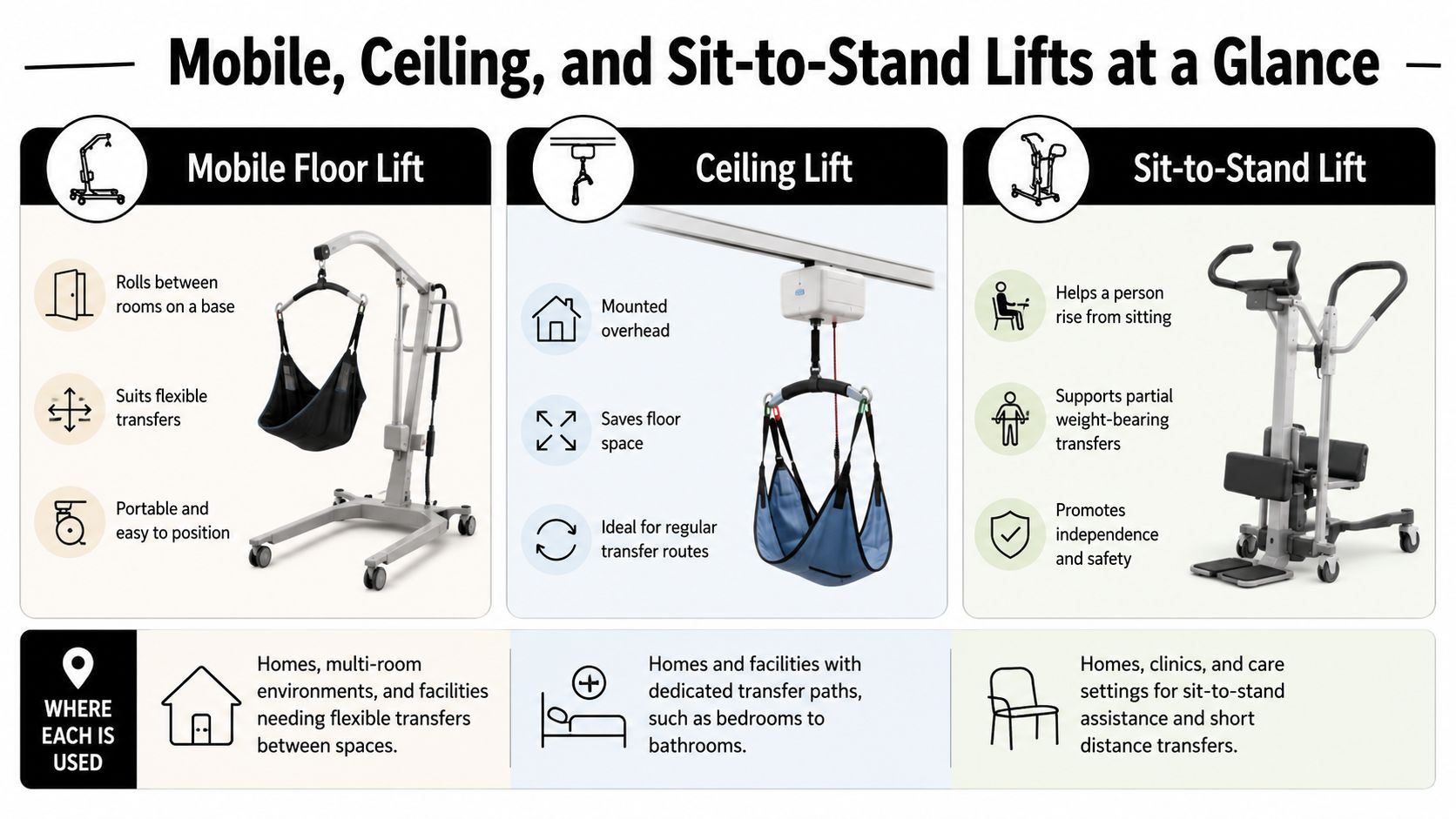
Three main types cover most situations. Mobile floor lifts roll between rooms. Ceiling lifts run on a fixed overhead track. Sit-to-stand lifts help someone who can bear some weight through their legs. None of them is the right answer for every transfer, and the sections that follow judge each type by the transfer it has to perform, the space it needs, and the sling it depends on.
Mobile, Ceiling, and Sit-to-Stand Lifts at a Glance
The three categories differ first in how they occupy a room. A mobile floor lift stands on a wheeled base with legs that open around a chair or bed. A ceiling lift hangs from a track mounted overhead and travels along it. A sit-to-stand lift has a smaller base, a footplate, and knee support, and it pulls the person up to a partial standing position rather than lifting them clear of the surface.
Mobile Floor Lifts
These suit transfers that happen in more than one place. You roll the lift to the bed, position the base legs under or around the furniture, attach the sling, and raise the person clear before moving them to a wheelchair, recliner, or commode. The trade-off is floor work. Someone has to push the loaded base, turn it, and get the casters over thresholds and carpet edges.
That pushing matters for safety. Evidence summarized by Ohio State applied ergonomics research found that ceiling-mounted systems produced lumbar spine forces considered safe in the evaluated tasks, while floor-based systems could raise anterior and posterior shear forces to unacceptable levels, as reported in CDC-indexed research on lift configuration and spine forces. Base design, caster resistance, and turning clearance aren't cosmetic details. They're part of the load on the caregiver.
Ceiling and Sit-to-Stand Lifts
A ceiling lift removes the loaded base from the floor entirely. The person travels along the track, and the caregiver walks beside them guiding the sling. That suits repeated transfers along one route, such as bed to chair in the same room. The limits are installation and reach. The track only goes where it's mounted, and the room structure has to support it.
Facilities planning that kind of fixed infrastructure often think about storage and room turnover at the same time, which is why it's useful to compare healthcare bed lift solutions alongside transfer equipment when a room refit is on the table.
A sit-to-stand lift is a different tool for a different person. The person must be able to bear some weight through their legs, hold onto the lift, and follow the movement. If they can't, this type isn't a cheaper alternative to a full-body lift. It's the wrong device.
Before assuming powered is your only route, it's worth understanding how manual hydraulic lifts differ in operation and effort, because the comparison clarifies what the motor removes from the caregiver's job.
Comparing Weight Capacity, Slings, and Battery Life
A lift can fit through a doorway and still fail the transfer if its sling is incompatible or its battery cannot cover the shift. Capacity, sling fit, battery life, and base dimensions work as one system. Match them to the transfers you perform, not to the largest number on a product sheet.
Manufacturer testing for the evaluated powered floor lift reported a reduction of back compressive forces on nursing personnel by an estimated 60% and listed a safe working load of 227 kilograms (500 pounds). These figures apply to that model and its testing, not every powered lift. The rated load is a ceiling, not a target. The person's weight must fall within the lift's rating and the sling's approved range. See the manufacturer's ergonomic testing of a powered floor lift and its safe working load.
Key Features to Compare Across Powered Patient Lift Types
| Feature | What to Check | Why It Matters in Use |
|---|---|---|
| Rated capacity | Safe working load compared with the person's actual weight | Staying within the rating helps avoid an unsafe transfer and equipment overload |
| Sling compatibility | Approval for the specific lift and its attachment style | An unapproved sling may attach or sit incorrectly, affecting support and posture |
| Sling type and size | Full-body, toileting, bathing, or sit-to-stand design, sized to the person | The sling affects comfort, hygiene access, and support during the transfer |
| Battery life | Run time per charge, charging method, and emergency lowering | If power runs out during a transfer, you need a way to lower the person safely |
| Portability | Base width, leg opening, caster size, and overall weight | These dimensions determine access through doorways and around furniture |
| Lift range | Lowest and highest lifting points | Low reach helps with floor recovery; high reach helps clear bed surfaces |
Capacity and Slings Are One Decision
The sling, supported by the lift, carries the person's weight. The motor raises and lowers the lift. Sling choice is therefore part of load planning, not an accessory decision. A high-capacity lift does not automatically accept every bariatric sling, and a sling within the person's weight range can still fit poorly.
Start with the transfer: toileting requires different access from bathing or repositioning. Review the main Hoyer lift sling types and what each is designed for, then confirm that the selected sling is approved for the lift and attachment points. That check can narrow the equipment options before you compare models.
Battery Life and Portability in Practice
Battery life matters in settings where transfers happen repeatedly without a reliable charging break. Check how charging works, whether the battery can be swapped, and how emergency lowering operates if power runs out while someone is suspended. Build charging into the household routine or shift handover. A powered lift with a depleted battery cannot complete a powered transfer.
Portability involves a practical trade-off. A heavier base can feel stable but take more effort to push over carpet and turn in a small bedroom. A lighter, narrower base may maneuver more easily, while offering less leg spread around a wide chair. Measure the narrowest doorway and tightest turn, then compare them with the base dimensions.
Practical rule: Choose around the heaviest person, the tightest doorway, and the longest stretch between charges. The lift and sling must work together through those conditions.
Safety Factors Beyond Motor Power
A motor removes the lifting effort. It doesn't position the sling, check the straps, or decide whether the person is secure enough to raise. Most of what goes wrong with a powered patient lift goes wrong in those steps, before the button is pressed.
FDA guidance is direct on the central point. No sling is suitable for every lift, a sling must be approved for the specific manufacturer's lift, and damaged slings should be stopped from use, as set out in FDA guidance on patient lift and sling safety. The same guidance describes falls involving lifts that caused serious injuries, including fractures and head trauma. This isn't a theoretical risk.
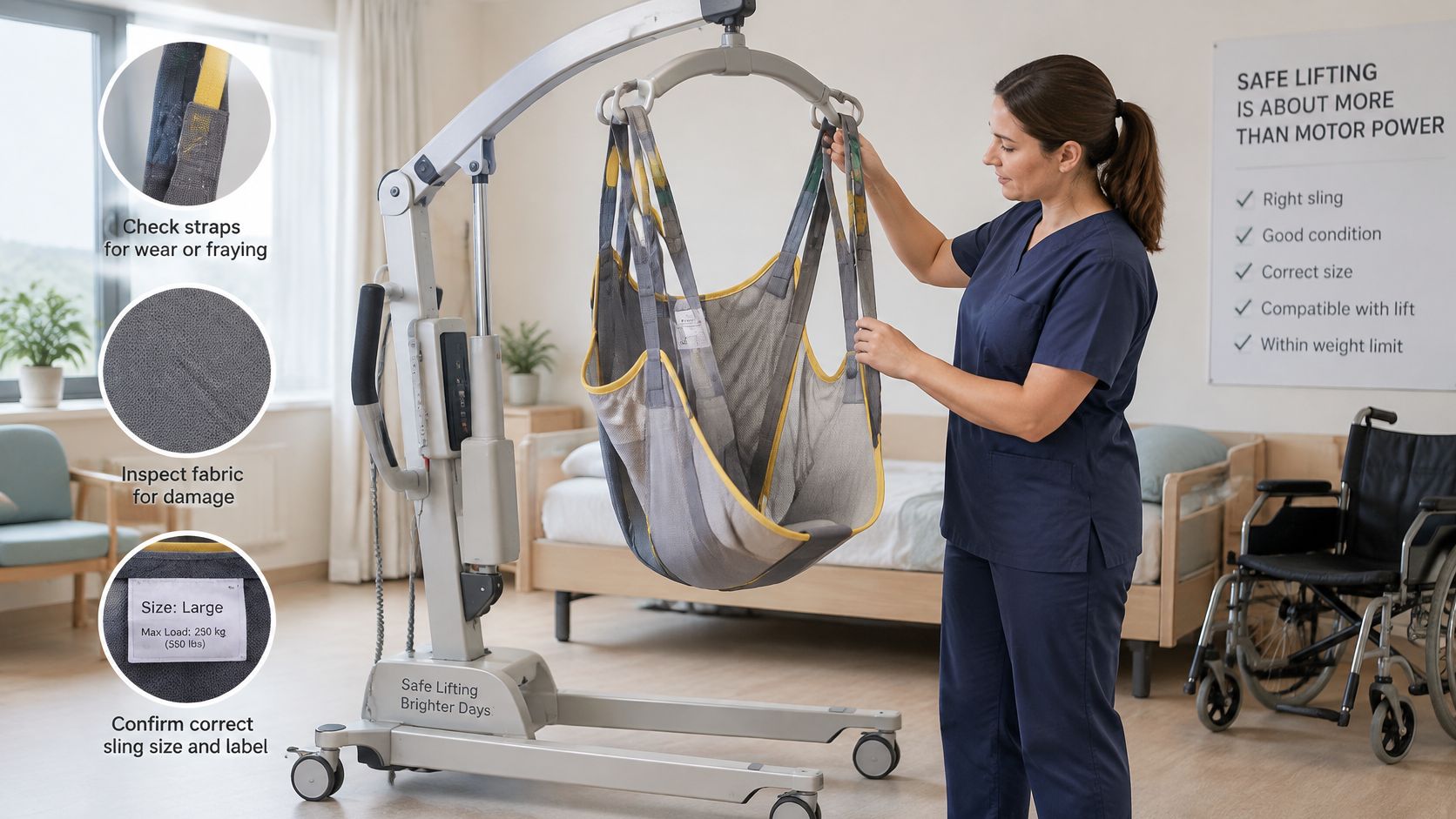
The image below shows the inspection step that should happen before a sling carries anyone.
Inspect the Sling Like It Carries the Load
It does. Before each use, run through the sling systematically rather than glancing at it.
- Fabric: Look for fraying, thinning, or torn areas, especially where the material folds under the person's weight.
- Straps and loops: Check for frayed edges, stretched stitching, and stress marks at attachment points.
- Seams: Pull gently along seams to confirm nothing is separating.
- Labels: Confirm the size and weight range still match the person you're lifting today, not six months ago.
If you find damage, retire the sling. Don't keep it as a backup. A worn sling paired with a strong motor is still a worn sling, and the lift's advertised capacity can't compensate for it.
Positioning, Training, and the Person in the Sling
Sling placement is where transfers succeed or fail. A sling positioned too low lets the person slide. One that's twisted or uneven changes their posture during the lift and can leave them insecure or uncomfortable. Careful placement takes time, and skipping it to save a minute is how people end up badly supported in mid-air.
Training matters for the same reason. Everyone who operates the lift should be able to demonstrate sling placement, attachment, raising, lowering, and emergency lowering without improvising. Reviewing safe patient transfer techniques for positioning and handling helps standardize those steps across family members or staff so the transfer doesn't change with whoever is on duty.
The video below walks through lift operation in practice, which is useful for seeing hand placement and sequencing rather than reading about them.
Finally, consider the person. Someone who is agitated, confused, or unable to cooperate can shift unexpectedly in a sling. That doesn't rule out a powered lift, but it changes which sling, how many caregivers, and whether the transfer should happen at that moment at all.
Matching Lift Types to Clinical and Home Use Cases
Start with the transfer, not the product category. A U.S. Department of Labor and NIOSH technical review found that floor-based and ceiling-mounted lifts substantially reduce caregiver back compressive forces per transfer compared with manual lifting, and that ceiling-mounted systems may suit repeated transfers in a fixed room, according to the Department of Labor and NIOSH technical review of patient lifts. Both types reduce load. They just fit different rooms and routines.
Bed to Wheelchair
This is the core transfer for a full-body mobile floor lift at home. The base legs need to fit under or around the bed, and the wheelchair needs space beside it with brakes locked. In a facility bedroom where this transfer repeats daily in the same spot, a ceiling track removes the pushing and turning entirely. At home, the mobile lift wins on flexibility, provided the floor is hard or low-pile and the turning space exists.
Bathroom and Toileting Transfers
Bathrooms expose mobile lifts. Doors are narrow, floors may be wet, and there's rarely room to turn a loaded base. A toileting sling gives access without a full re-dressing routine, but only if the lift can physically get into position. Measure before you buy. If the base can't enter, a ceiling track over the route, or a different transfer plan altogether, beats forcing equipment through a doorway.
Thinking about what the person can still do for themselves helps here. Reading a clinician's guide to independent living can clarify which daily activities the person manages independently and which ones need full mechanical support, which in turn shapes whether a sit-to-stand device is realistic.
Recliner Transfers and Floor Recovery
Recliners sit low and wide, so base leg spread and lift range decide whether a mobile lift can reach in and raise the person clear of the arms. Floor recovery after a fall is the harder test. The lift must lower far enough to attach a sling to someone at floor level and raise them without dragging. Not every model does this well, so check the minimum lifting height if falls are part of your planning.
For someone who can bear partial weight and is working on regaining standing ability, how a sit-to-stand patient lift supports partial weight-bearing transfers explains where that category fits. In facilities, remember a shared lift serves residents with different weights and dependency levels, so sling inventory and staff training matter as much as the lift itself.
How to Choose the Right Powered Patient Lift
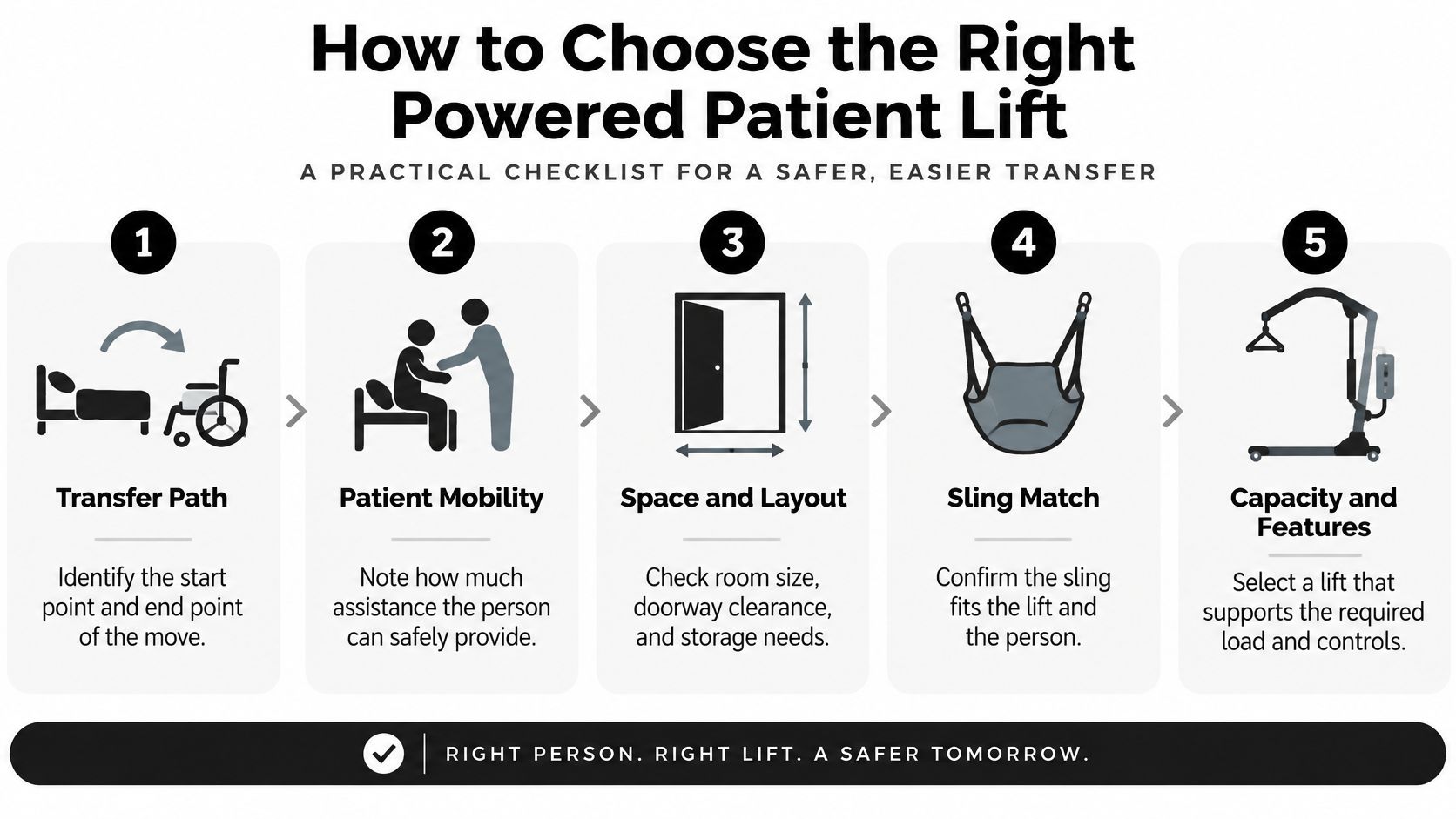
Work through the decision in the order a transfer happens. Start where the person is, end where they need to be, and let everything between those points narrow your options.
A Working Checklist
- Map the transfer path: Write down the start point, end point, and everything between them. Note thresholds, carpet, rugs, and the tightest turn. If a mobile base can't travel that path loaded, it's the wrong lift regardless of its other features.
- Assess dependency: Can the person bear weight through their legs, grip a handle, and follow instructions? If yes, a sit-to-stand lift is worth considering. If they're non-weight-bearing or highly dependent, prioritize a full-body powered lift.
- Count caregivers: Some transfers need two people, one operating the lift and one guiding the person and the destination chair. If you're usually alone, that constraint should shape the sling and lift you pick.
- Decide fixed or mobile: Transfers repeating in one room favor a ceiling track. Transfers across several rooms favor a mobile base. Don't buy mobility you won't use, and don't fix a track where routines change often.
- Verify capacity as a system: Compare the person's actual weight against the lift's safe working load and the sling's approved range. Both must cover it, with the sling approved for that manufacturer's lift.
Details That Get Overlooked
Storage is one. A mobile lift that lives in a hallway because there's nowhere to park it becomes an obstacle. Measure where it will sit between transfers, charger access included. Flooring is another. Deep carpet increases pushing force on a loaded base, which brings back some of the caregiver strain the lift was meant to remove.
This kind of methodical checking applies to any equipment purchase where fit matters more than features. The same mindset shows up in Labs USA advice on laboratory furniture, where matching equipment to the actual workspace prevents expensive mismatches. The principle transfers directly. Measure your space, then shop.
If you're building out a broader home setup rather than solving one transfer, home care equipment for elderly people living at home covers how lifts sit alongside beds, chairs, and bathroom equipment so the pieces work together instead of competing for the same floor space.
The cheapest lift that fits your room, your person, and your sling is a better buy than the strongest lift that fits none of them.
There's no single winning model in this category. There's a right match for a specific person, room, and caregiver, and the checklist above is how you find it.
Verifying Specs and Taking the Next Step
Before ordering any powered patient lift, confirm a short list of details on the product page. These checks take minutes and prevent the most common mismatch returns.
- Rated capacity: Confirm the safe working load covers the person's current weight.
- Sling compatibility: Confirm the exact sling model is approved for that lift, and that the size you need is available.
- Battery details: Note charging time, how the battery is replaced, and whether emergency lowering is built in.
- Base dimensions: Check leg spread, base width, and minimum lifting height against your room measurements.
- Warranty terms: Read what the warranty covers on the frame, motor, and electronics, and for how long.
Concrete models make this easier to apply. The Freedom Aqua Waterproof Powered Patient Lift and the Freedom Electric Mobile Transfer Patient Lift each carry a 300 lb weight capacity, while options like the Drive Levantar Battery-Powered Patient Floor Lift and the Bestcare Bestlift PL228 HD Care Electric Patient Mobile Lift serve heavier-duty mobile transfer needs. Comparing two or three models side by side against your checklist tells you more than reading any single product description.
DME Superstore supports that comparison with clear specs, compatibility accessories, and warranty information on its product pages, plus 24/7 chat support when you need to confirm a sling match before ordering. Nationwide free shipping, a 30-day return policy on most items, FSA and HSA eligibility, Affirm financing, and optional white-glove delivery round out the practical side of the purchase. Shortlist your models, verify the sling and capacity one final time, then order.
Compare powered patient lifts, slings, and transfer aids with clear specifications and compatibility details at DME Superstore, and use the 24/7 chat support to confirm your sling and capacity match before you buy. With nationwide free shipping and flexible payment options, you can order the lift that fits your transfer path and have it delivered to your door.

