



You're standing beside a loved one who's ready to walk from the kitchen to the living room. Their phone is on the counter, medication is in the bedroom, and a water bottle is too awkward to carry while both hands remain on the walker. A walker bag can remove that small but important obstacle, but only if it fits the frame, stays balanced, and remains easy to use.
The right choice isn't merely the roomiest or most washable bag. Mounting position, walker type, brake access, folding clearance, closure design, and everyday load all affect whether the accessory supports independence or creates another problem. This guide explains how to compare walker bags for seniors, measure compatibility, and choose storage that matches real routines.
Why Walker Bags Matter for Daily Independence
A walker occupies both hands because that's how it provides support. That design helps with movement, but it leaves no safe hand free for a phone, book, medication container, or drink. A walker bag turns part of the frame into reachable storage, so the user can keep both hands where they belong.
Mayo Clinic guidance describes a pouch attached to the side of a walker as a way to carry books, a phone, and other items, while baskets can be useful for shopping. A walker with a seat serves a different purpose, giving the user a place to rest during a walk. These distinctions matter because storage, carrying capacity, and rest support aren't interchangeable features. (Mayo Clinic guidance on walker bags and accessories)
Storage as an independence tool
Consider a senior who likes to read in the morning. Without a pouch, they may need to make several trips, ask someone else to carry the book, or place it precariously on the walker. With a properly fitted bag, the book and phone can travel with them while their hands stay on the grips.
Walker bags are part of a wider group of walker accessories designed to solve this practical problem. Neutral industry guidance notes that pouches and bags can hold phones, medications, books, and canes without the added weight of a basket, while keeping belongings close and more private. (Walker accessories for everyday storage)
That convenience can support routines connected with independent living, including managing personal items and moving between daily activities. Families supporting someone with memory loss may also find a practical companion in this dementia care independent living guide. For broader ideas about adapting the home and routines, see this resource on staying independent while aging in place.
Why a bag may suit lighter needs
A basket usually offers an open, rigid space for larger objects. A fabric bag often feels less bulky and can keep personal items out of view. That privacy can matter when the contents include medication, paperwork, or personal care supplies.
The practical question is not “Which bag holds the most?” Ask instead, “What does this person carry every day, and can they reach it without changing their grip or posture?” That question leads to a safer choice than shopping by appearance alone.
Comparing Walker Bag Styles and Mounting Systems
Walker bags that look nearly identical in online photos can behave very differently once attached. The mounting location changes how quickly the user can reach belongings, whether the walker folds, and whether a rollator seat or brake handle remains clear.
| Bag Style | Mounts Where | Best For | Watch Out For |
|---|---|---|---|
| Over-the-bar front pouch | Around the front bar or upper frame | Users who need items visible and close | May interfere with folding or hand clearance |
| Under-seat rollator bag | Beneath the rollator seat | Users who want storage out of the way | Can be difficult to reach without bending |
| Side tote | Along one side of the frame | Carrying more personal items | Uneven loading can affect balance |
| Organizer-style bag | Front, side, or frame-mounted straps | Users who need separated pockets | Extra compartments can encourage overfilling |
Front pouches and organizer bags
An over-the-bar front pouch is often convenient for a phone, glasses, tissues, or medication. The opening sits within the user's field of view, which can help someone with limited reach or vision. Its limitation is frame interference. Straps can crowd the handles, folding points, or brake cables if the pouch is positioned too high or too close to the center.
An organizer-style bag adds pockets and sections. That layout can help a caregiver place items in predictable locations, such as the phone in one pocket and hearing aid supplies in another. The trade-off is that a more structured bag may occupy more frame space and become awkward if the walker folds tightly.
Under-seat bags and side totes
An under-seat rollator bag keeps storage below the seat, leaving the front frame visually open. It can work well for a rollator user who wants the seat and handles unobstructed. The drawback is access. A person with limited flexibility, weak grip, or difficulty bending may struggle to retrieve items safely.
A side tote offers a different compromise. It can provide useful capacity without covering the front bar, but one-sided loading may shift the walker's balance. The bag should stay close to the frame, and heavy items shouldn't be placed on one side because there's room.
For a broader look at carrying systems that move with wheeled equipment, this Urban Totes go-anywhere carry guide offers useful context about attachment and transport design. Rollator users can also review what a rollator walker is before choosing an accessory made for a seat-and-brake frame.
The main lesson is simple: mounting style matters as much as bag capacity. A front pouch may be ideal for quick access, while an under-seat model may be better for keeping the seat and controls open.
How to Measure Your Walker Before You Buy
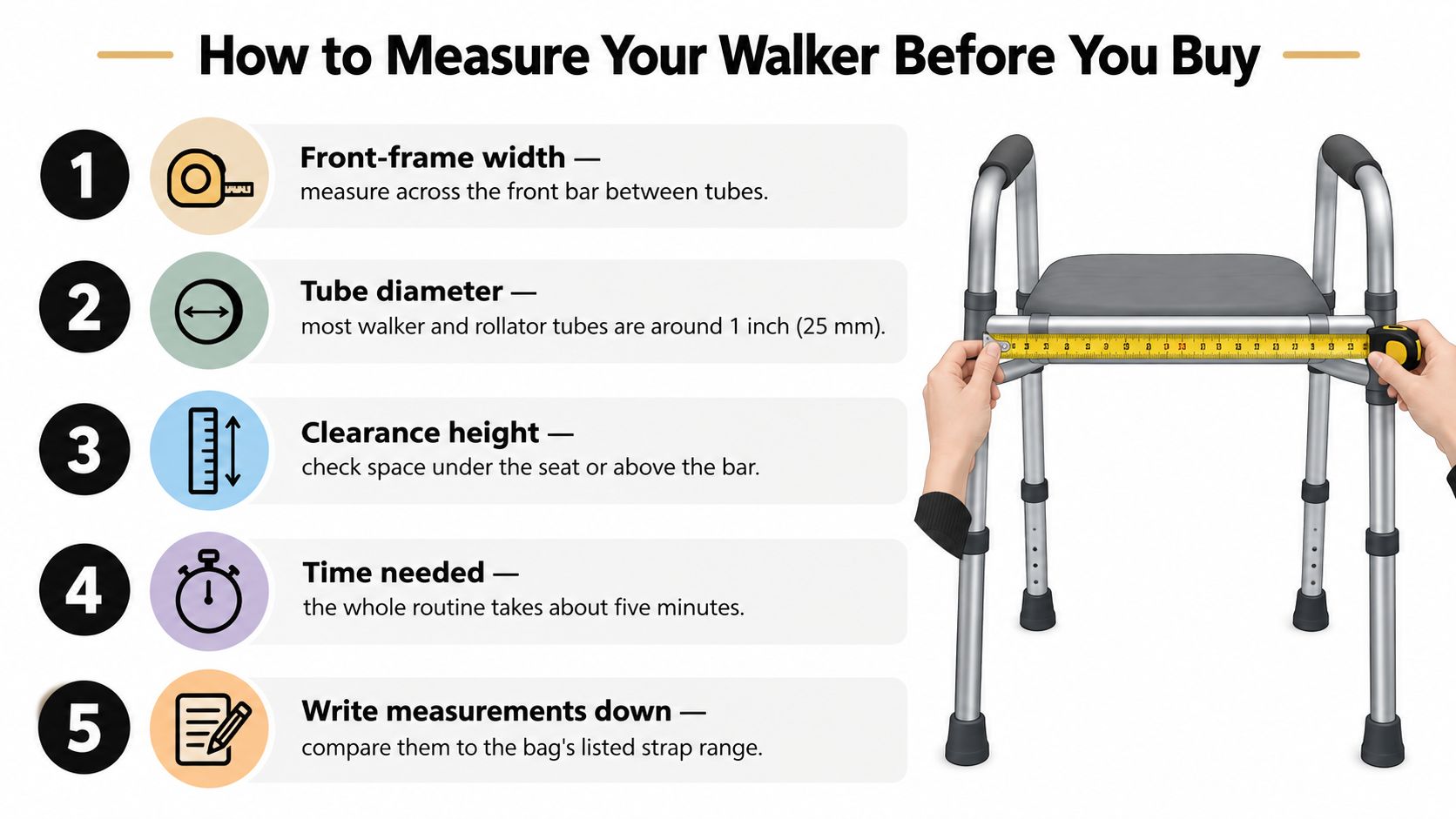
A five-minute measurement routine can prevent the most frustrating fit problems. Use a tape measure, inspect the frame in the condition it's usually transported, and write the results down before comparing product specifications.
Start with the frame, not the product photo
Measure the front-frame width across the area where the bag will attach. Many adult walkers fall near 24 to 28 inches wide, but the actual frame in front of you is more important than a general range. (Walker measurement and compatibility guidance)
Next, check the tube diameter. Many walker and rollator tubes are around 1 inch, but heavy-duty and bariatric frames may use different tubing. A strap that wraps neatly around a narrow tube may not close securely around a larger one.
Measure in the walker's folded or travel condition, not only when it's fully open. A bag can appear to fit the open frame yet block the folding mechanism when the walker is placed in a car. If the user transports the walker frequently, folding clearance should be treated as a core requirement.
Check every point the bag could affect
Look at the space around the handles, brake levers, wheels, seat, and hinges. The bag shouldn't push into the user's hands or block a brake cable. On a rollator, check that the seat can open and close and that the bag doesn't reduce leg or foot clearance.
Wheel clearance deserves special attention. Practical guidance recommends leaving roughly 1 to 2 inches between an accessory and the wheels, while ensuring brakes and folding hinges remain unobstructed. (Walker bag fit and clearance guidance)
A caregiver should also examine how the attachment works:
- Wraparound straps can fit several frame shapes but may require finger strength.
- Hook-and-loop closures are adjustable and often easier for one-handed use.
- Clips or rigid brackets can feel secure, but they may be less forgiving when the frame shape differs from the product design.
Use this quick verify list
Before ordering, record:
- Front-frame width.
- Tube diameter.
- Handle and brake clearance.
- Wheel and foot clearance.
- Seat clearance, if the device is a rollator.
- Folding-point clearance.
- Strap range and attachment method.
- Whether the user can open the bag with one hand.
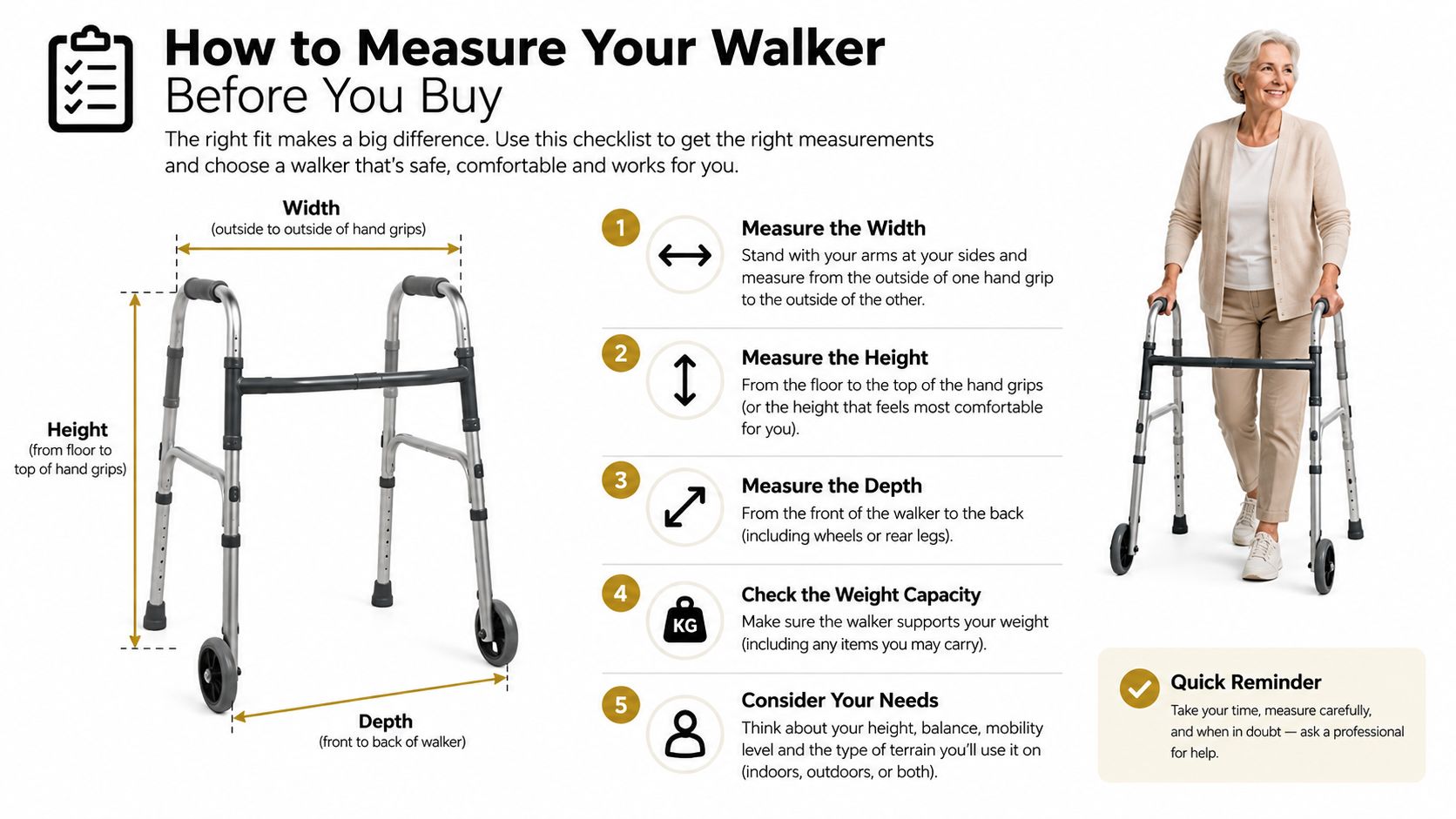
If the product page doesn't show strap dimensions, tube compatibility, or folding information, don't assume the bag is universal. Compare the listed measurements with your notes, and ask the seller for clarification before attaching anything to a frame used for standing support.
Capacity, Materials, and Everyday Accessibility
Fit determines whether a bag can attach. Material and opening design determine whether the user will use it comfortably. A senior may abandon a technically compatible bag if the zipper is stiff, the lining is hard to see into, or the contents become one tangled mass.
Washable, water-resistant nylon is practical for daily errands and outdoor use. It's usually lighter than a rigid organizer and can be removed for cleaning. Rigid panels, on the other hand, help the bag keep its shape. That can make it easier to locate a phone or inhaler without searching through soft fabric.
Match the opening to the user
A zipper can secure contents during movement, but it may challenge someone with arthritis, reduced finger strength, or limited vision. A magnetic closure may be easier to operate, although it still needs to close securely. An open-top design offers the fastest access, but it provides less protection from spills and may allow items to fall out.
The contents should guide the compartment layout. A useful everyday arrangement might include:
- A phone pocket that can be reached without leaning.
- A protected space for insulin supplies or an inhaler.
- A small section for a hearing aid case.
- A bottle compartment that keeps liquid upright.
- A flat pocket for therapy cards, appointment details, or caregiver notes.
The goal isn't to fill every pocket. The goal is to keep essential objects visible, separated, and easy to return to the same place.

The larger bag isn't automatically the safer bag. A smaller, structured organizer may be easier to open, easier to keep orderly, and less likely to swing than a large soft tote.
Why oversized storage can backfire
A large tote invites accumulation. A few purchases, extra clothing, a water bottle, and miscellaneous items can quickly become a shifting load. If the bag swings while the user turns, or if it makes the walker harder to fold, its capacity has become a liability.
A guide to walker accessories for older adults can help caregivers think beyond storage and consider the whole mobility setup. The best accessory supports the user's routine without changing the way they grip, steer, brake, sit, or stand.
Safety, Weight Limits, and Balance
The most important buying question is often left out of product descriptions: Will this bag make the walker less stable or harder to control? Any load attached to the front or side can change the walker's center of gravity, especially when the contents are heavy, loose, or unevenly distributed.
Neutral safety guidance suggests keeping everyday carried weight light, often in the 2 to 5 pound range for small walker bags, unless the product instructions explicitly support more. (Walker accessory safety guidance) This is a practical starting point, not permission to load every bag to its maximum.
Mounting position changes the risk
A front-mounted bag places weight ahead of the user. That can make the walker feel less stable during a turn or when the user lifts and repositions a standard walker. A side tote can create uneven loading, particularly if a bottle or other dense item stays on one side.
An under-seat rollator bag keeps weight lower and away from the front handles, but it still needs to remain clear of the wheels and seat mechanism. Its lower position doesn't remove the need to check balance or make bending safe for the user.
Never attach a bag to a part used for steering, braking, folding, or standing support. A strap around a brake cable can restrict movement. A pouch near a hinge can prevent a full fold. A bag that forces the user to release one hand to reach an item may also undermine the walker's purpose.
Test the loaded frame
Install the bag and begin with a light everyday load. Walk on a clear surface, make a controlled turn, apply the brakes if the device has them, and try the folding action if applicable. Watch for swinging, rattling, dragging, or any change in the user's grip.
Medical guidance emphasizes proper walker fitting and notes that some users need adequate upper-body strength and balance to use mobility aids safely. Incorrect use of assistive devices can contribute to falls and injuries, so an accessory should reinforce safe habits rather than encourage reaching, leaning, or one-handed walking. (American Academy of Family Physicians guidance on walkers and fall prevention)
A bag should make essentials easier to carry, not make the walker responsible for carrying a person's weight.
If the user has significant balance loss, weakness on one side, or difficulty understanding how the accessory affects movement, ask a clinician or mobility professional to review the setup.
Choosing a Bag for Travel, Errands, and Caregiving
A walker bag should match the outing and the person managing it. A setup that feels convenient at home may become difficult in a crowded shop, while a large errand bag can add unnecessary bulk during a short trip.
For travel
Travel usually calls for a bag that detaches easily or folds flat with the walker. Medication, identification, appointment papers, and travel documents should remain secure but reachable. Check the folding path before each trip, especially when the walker must fit into a car trunk or be prepared for transport.
A removable pouch can work well because it separates from the frame during loading. Detaching it adds another task, however. Someone with limited hand strength may need a caregiver to release the straps and reattach the pouch correctly.
For daily errands
Errands need moderate capacity, a dependable closure, and a mounting position that stays stable while walking. A bag can carry a phone, wallet, water, and small purchases without hanging near the wheels or extending into another person's path. Keep frequently used items where the user can reach them without twisting or leaning.
Storage under the seat often suits a rollator because it uses space already built into the frame. A standard walker user may reach a front organizer more easily. The choice is a fit decision as much as an access decision. The pocket closest to the hand still fails if it covers brake handles, catches on a hinge, or makes folding awkward.
For caregiving
Caregivers often need orderly storage more than maximum capacity. Divided sections can separate scheduled items, caregiver notes, hearing aid supplies, and a phone, making handoffs easier and reducing rummaging while the user is standing.
For users carrying more items across a walker, rollator, or transport routine, a nova extra-large carry travel bag may provide additional room. Size alone does not confirm suitability. The caregiver should verify frame compatibility, attachment clearance, folding or seat access, and the product's stated load guidance before use.
A practical compromise is to pack only what belongs to that outing. A medical appointment setup does not need the supplies reserved for a full shopping trip. This keeps the bag easier to lift, reach into, and control.
Our Recommendations and Buying Checklist
A good choice starts with the user's frame and routine, not with a universal label. These recommendations provide a practical way to narrow the field:
- Typical senior using a standard walker: Choose a compact front or organizer pouch with adjustable attachment points, clear brake and handle access, and a closure the user can operate.
- Rollator user: Look first at an under-seat or model-compatible organizer that preserves the seat, brake handles, and wheel path.
- Bariatric or heavy-duty frame: Confirm tube diameter, width, attachment strength, and listed compatibility directly. Do not rely on a standard walker bag merely because its straps appear adjustable.
- Limited dexterity or vision: Favor a smaller structured bag with large, easy-to-identify compartments and a magnetic or straightforward opening. A caregiver can help test whether the user can find and replace items without leaning.
Final review checklist
Before buying, confirm:
- Frame fit: You measured width, tube diameter, clearance, and folding points.
- Device type: The product specifically supports a standard walker, rollator, wheelchair, scooter, or the user's frame.
- Control access: Brakes, handles, hinges, wheels, and seat functions remain unobstructed.
- Load guidance: Everyday contents stay light, often within the 2 to 5 pound range for small bags, unless the instructions state otherwise. (Walker accessory safety guidance)
- Daily contents: The bag accommodates the phone, medication, water, hearing aid case, inhaler, or caregiver notes the user carries.
- Opening method: The user can operate the closure with their available grip and vision.
- Transport needs: The bag detaches or folds appropriately if the walker travels by car.
- Product details: You checked compatibility information, weight specifications, return terms, and warranty details on the product page.
Walker bags for seniors work best when they remove a specific daily obstacle without creating a new safety concern. Measure first, carry only what the user needs, and test the loaded walker before making the accessory part of a daily routine.
DME Superstore offers mobility bags and related walker, rollator, and wheelchair accessories alongside durable medical equipment for home mobility and caregiving needs. Review the compatibility details and specifications, then visit DME Superstore to compare options for a safer, more independent routine.
