



If a mattress has a pump, air cells, and electronic controls, does that automatically make it better at protecting someone's skin? Not necessarily. The useful question is which care need the mattress addresses, and whether it fits the person, bed, and caregiving routine.
Understanding the types of pressure relieving mattresses starts with separating continuous support from powered pressure changes. Comfort matters, but a comfortable retail mattress and a clinically suitable pressure-redistribution surface aren't interchangeable.
Types of Pressure Relieving Mattresses at a Glance
Static surfaces spread pressure continuously without powered changes. Dynamic surfaces use electricity to change support over time. That's the simplest sorting rule, although product names don't always respect it.
The Cochrane review of support surfaces distinguishes reactive surfaces, which respond to the person's load, from active surfaces that change pressure mechanically. One important qualification is that power doesn't always mean alternating pressure. A powered system may maintain airflow without cycling the load between cells.
Main pressure-relieving mattress types compared
| Type | Category | How it redistributes pressure | Needs electricity | Typical use |
|---|---|---|---|---|
| High-specification foam | Static | Engineered foam spreads load over a larger contact area | No | Baseline surface for adults at high risk |
| Gel or fluid overlay | Static | Viscous material conforms to the body | No | Added comfort and support on an existing bed |
| Bead-filled surface | Static | Beads mould around body contours | No | Continuous support without pumps |
| Static air | Static | Air cells hold a set inflation level without cycling | No | Support where powered changes aren't wanted |
| Alternating-pressure air | Dynamic | Cells inflate and deflate in cycles to shift load | Yes | Added redistribution when foam isn't enough |
| Low-air-loss | Powered, often grouped with dynamic systems | Air escapes through small openings to help dry the skin | Yes | Users with moisture exposure and long periods lying down |
| Reactive air | Static/reactive | Cells adjust to the body's weight | No for nonpowered models; some systems use power | Evidence-supported option for adults at risk |
The typical-use column is a starting point, not a prescription. Low-air-loss describes an airflow feature, while alternating pressure describes a loading pattern. A single mattress can offer both.
Air-filled products are common in shopping results: Straits Research reports that they represented 56.90% of the global pressure-relief mattress market in 2025, while 6Wresearch places foam at approximately 35%. These are separate market estimates, not evidence that either category is clinically superior.
For readers comparing ordinary bedroom mattresses alongside medical equipment, Slone Brothers Furniture's Orlando guide to pressure relief mattresses offers additional shopping context. Keep comfort comparisons separate from decisions about pressure-injury prevention.
Starting point: Choose by risk, mobility, skin condition, moisture exposure, and access to power, not by how complicated the mattress looks.
How Static Surfaces Spread Pressure
Say a family caregiver is preparing a bed for someone who spends much of the day lying down but can still help with turning. A suitable static surface can provide continuous support without adding pump controls to the daily routine.
High-specification foam is the usual baseline to discuss. Its construction allows the body to sink into the surface, called immersion, while the material follows body contours, called envelopment. Think of carrying a shopping bag with a wide padded handle rather than a thin cord: spreading the load reduces concentration at a small contact area.
NICE guidance on pressure-redistributing devices supports high-specification foam for adults at risk and explains that suitability includes the person's weight, posture, mattress construction, and care arrangements. Foam thickness and density matter, but neither alone proves clinical performance.
What the materials mean at home
- High-specification foam: A replacement mattress on an adjustable homecare bed can provide continuous support. Its limitation is that the wrong construction or capacity may allow excessive compression, especially beneath concentrated body weight.
- Gel or fluid overlays: An overlay can conform around the body on an existing compatible mattress. The drawback is the additional handling burden and bed height, so check its weight and the resulting transfer position.
- Bead-filled surfaces: Loose filling can mould around contours, rather like a bean-filled cushion settling around a hand. Check the capacity and care instructions, because the material name alone doesn't establish suitability.
- Static air: Noncycling air cells support someone who doesn't need powered changes. Incorrect inflation can compromise support, so use the manufacturer's checking method rather than judging firmness by touch alone.
Our foam hospital bed mattress guide provides further context for comparing foam products. Look beyond descriptions such as soft, premium, or orthopedic, and identify the intended user, compatible frame, cover construction, and transfer support.
Quiet doesn't mean care-free
A nonpowered surface has no pump noise, pump alarms, or dependence on an electrical outlet. However, its cover still needs cleaning and inspection, and the mattress needs checking for damage or loss of support.
Static also doesn't mean rigid or unresponsive. The material can change shape under the person while remaining in the same operating mode.
A pressure-redistributing mattress supports a care plan. It doesn't replace turning assistance, skin checks, or keeping the person clean and dry.
How Alternating-Pressure and Low-Air-Loss Mattresses Work
Think of a row of seats taking turns supporting a shared load. In an alternating-pressure mattress, one group of air cells becomes firmer while another relaxes, changing which areas carry more weight.
The person isn't lifted completely clear of the mattress. Instead, the system changes support beneath different body regions to reduce how long an area remains under the same loading conditions. The Cochrane review of alternating-pressure air surfaces describes this mechanical change and distinguishes it from airflow used to manage moisture.
Pressure duration and moisture are different jobs
Alternating pressure addresses loading over time. Low-air-loss addresses the skin's microclimate, meaning the heat and moisture conditions near the skin.
Low-air-loss systems release air through small openings. That airflow helps moisture escape, but it doesn't replace prompt continence care, appropriate bedding, or cleaning after an episode of incontinence. Nor should buyers assume that an ordinary air mattress provides low-air-loss treatment.
Some specialized systems use air-fluidised support, forcing filtered air through ceramic beads to create a fluid-like supporting medium. This isn't the same as a nonpowered bead-filled surface, despite the shared reference to beads.
For a closer look at cell cycling and controls, use our explanation of what an alternating-pressure mattress is. When comparing models, identify the actual functions rather than relying on an air-mattress label.
What powered support adds to the routine
A powered mattress brings practical responsibilities alongside its potential benefits. The pump needs a suitable location, tubing must remain unobstructed, and caregivers need to understand the settings.
Some people notice cell movement or pump sound when trying to sleep. Alarms may signal low pressure, a disconnected hose, or another fault, but the meaning and response are model-specific. Ask for a demonstration of normal operation and fault handling before the person relies on the surface.
Caregivers also need access to the emergency-deflation control where fitted. Follow the device instructions and clinical emergency plan rather than assuming that disconnecting the pump is the correct response.
A dynamic surface is a specific tool, not an automatic upgrade. People who may need assessment for one include:
- People inadequately supported on foam: Their skin response or clinical assessment suggests that the current surface isn't redistributing pressure adequately.
- People with substantial moisture exposure: Their care plan may benefit from low-air-loss functionality alongside direct moisture management.
What the Evidence Says About Active Versus Foam
The newest or most elaborate mattress isn't automatically the most effective choice. Comparisons become misleading when sellers treat ordinary foam, high-specification foam, reactive air, and alternating-pressure air as interchangeable categories.
The table separates those comparisons. RR means risk ratio, and CI means confidence interval. The direction of the comparison matters: foam versus air isn't the same wording as air versus foam.
Reported outcome estimates for foam and active air surfaces
| Comparison | Outcome | Estimate | Certainty |
|---|---|---|---|
| Reactive air vs ordinary foam | New pressure ulcers | RR 0.46 (95% CI 0.29-0.75) | Low |
| Alternating-pressure air vs ordinary foam | New pressure ulcers | RR 0.63 (95% CI 0.42-0.93) | Low |
| Foam vs alternating-pressure air | New pressure ulcers | RR 1.59 (95% CI 0.86-2.95) | Low |
| Foam vs reactive air | New pressure ulcers | RR 2.40 (95% CI 1.04-5.54) | Low |
| Alternating-pressure vs low-air-loss in ICU patients | Pressure-injury occurrence | 8.9% vs 10.9% | Not specified in the study summary |
The ordinary-foam estimates come from the Cochrane support-surface review identified earlier. For the other foam comparisons, the Cochrane foam-surface review reports RR 1.59, with a 95% CI of 0.86 to 2.95, against alternating-pressure air, and RR 2.40, with a 95% CI of 1.04 to 5.54, against reactive air, both with low-certainty evidence.
The systematic review indexed by PubMed reports pressure-injury occurrence of 8.9% versus 10.9% for alternating-pressure and low-air-loss surfaces in adult intensive-care patients. That difference wasn't statistically significant, and it shouldn't be converted into a universal homecare ranking.
Reading the uncertainty
A risk ratio below one favours the first surface listed for preventing new injuries. When the confidence interval crosses one, the findings don't establish a statistically significant difference. Low certainty means the estimate may change with better evidence.
A systematic review of alternating-pressure support also found insufficient evidence to declare alternating-pressure mattresses better than other support surfaces generally.
The Cochrane foam review's economic analysis estimated a 99% probability of cost-effectiveness at a GBP 20,000 willingness-to-pay threshold. That is an economic-model result, not a mattress price or guarantee of individual benefit.
Our low-air-loss versus alternating-pressure comparison helps translate these categories into practical questions. The principle of matching treatment to the person also appears in Pain and Sleep Therapy Center's explanation of who qualifies for an oral appliance, although that resource concerns a different condition.
No surface eliminates the need for repositioning, skin inspection, moisture management, and appropriate nutrition.
Fit, Power and Caregiver Checks Before You Buy
A weight-capacity label doesn't establish that a mattress fits the person. The international pressure-injury quick-reference guidance emphasizes accommodating weight, height, size, and body-mass distribution when selecting full-body support.
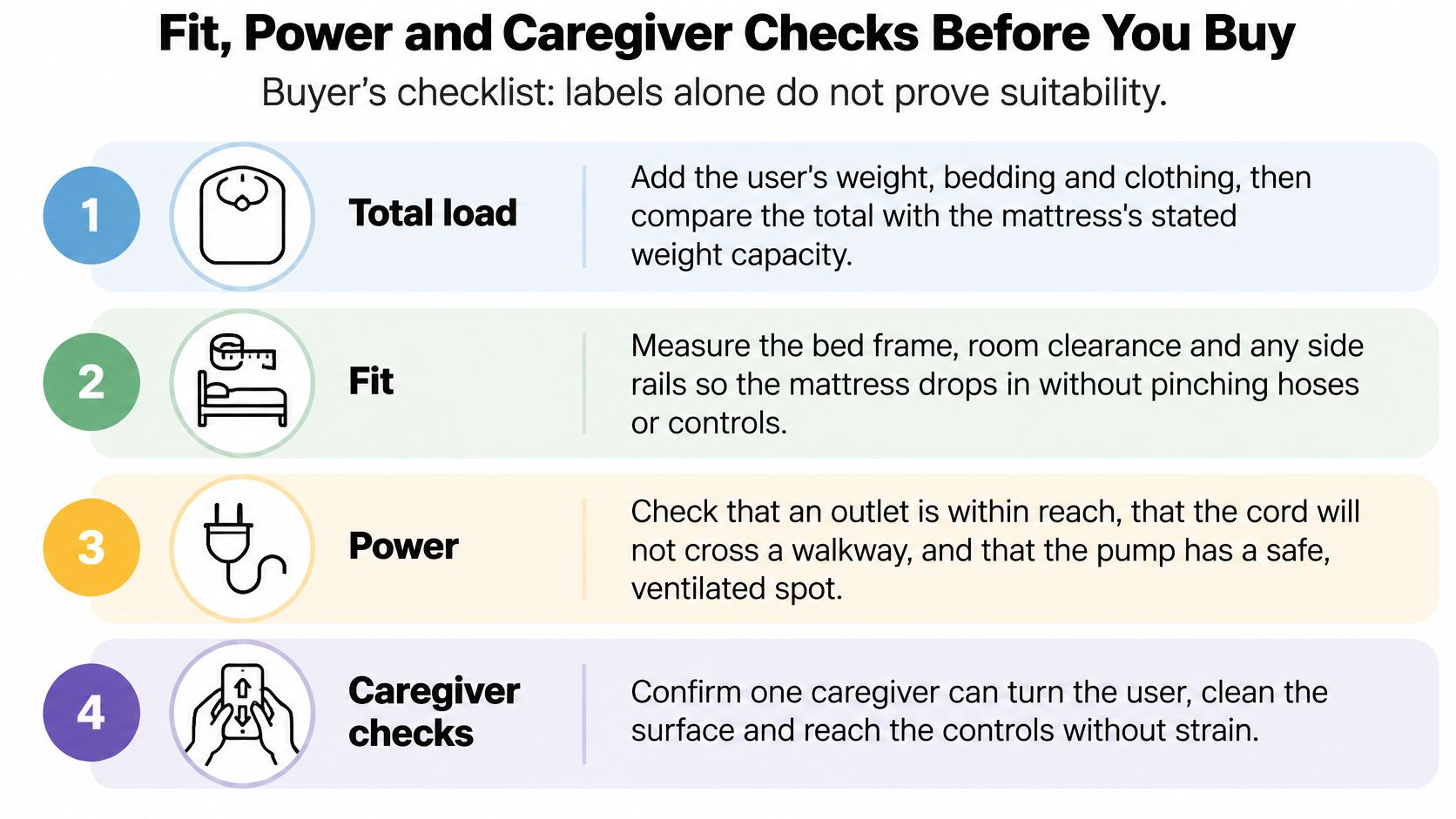
Use the checklist to assess the complete bed setup, not just the mattress in isolation.
Check the person and frame first
- Total load. Add the user's weight, bedding, and clothing, then compare the total with the stated mattress capacity and its definition. A surface may be unsuitable if someone checks body weight alone and overlooks other supported loads.
- Dimensions. Measure the frame's usable length and width, then check rails, hoses, and room clearance. A tall person's heels may approach the end even when their weight is comfortably within the limit.
- Frame compatibility. Confirm that the mattress is approved for the bed's articulation. An incompatible surface can buckle or pull away from the frame when the head section rises.
- Edge support. Assess transfers using the intended technique and assistance. A soft edge may collapse beneath someone who sits there before standing, even if the central sleeping area feels supportive.
Check operation and access
- Pump placement and cords. Choose a ventilated, accessible position and route cords away from walking routes and moving bed parts. A cord caught beneath the frame can be damaged during height adjustment.
- Emergency deflation. Identify the release mechanism, where fitted, and learn the manufacturer's procedure. Bedding covering the control can delay access when speed matters.
- Power and backup. Establish what happens during an outage, including how long support is maintained if the manufacturer specifies it. Don't assume an inflated surface will remain clinically effective after power fails.
- Caregiver access. Check access for sheet changes, cleaning, controls, and assisted movement. A bed pushed tightly against a wall may prevent the planned turning technique.
Our guide to electric hospital beds for home use can help you assess the frame alongside the surface. Bed height adjustment and mattress pressure redistribution solve different problems, so verify both.
Before ordering: Seek clinician input for an existing injury, severe immobility, or unusual body shape. Those situations require more than matching a weight to a capacity label.
Matching a Surface to Risk and Finishing Your Choice
Begin with the person's care needs, then select the least complicated surface that meets them. Reliable electricity alone isn't a reason to choose a powered mattress.
Use this decision sequence:
- Identify the care picture. Record mobility, skin damage, moisture exposure, ability to reposition, and power reliability.
- Discuss high-specification foam as the baseline. NICE guidance recommends it for adults at high risk and adults who already have a pressure ulcer.
- Escalate for an identified problem. Consider alternating-pressure support when redistribution is inadequate, or low-air-loss when moisture management needs additional help.
- Confirm before ordering. Have a clinician review uncertain cases and complete the fit, transfer, and operating checks.
Which surface to discuss for each care need
| Care need | Surface to discuss | Reason |
|---|---|---|
| Adult at high risk, no existing ulcer | High-specification foam | NICE names it the baseline for adults at high risk |
| Existing pressure ulcer | High-specification foam, with a dynamic surface if needed | NICE recommends foam for adults who already have an ulcer |
| Foam not redistributing pressure enough | Alternating-pressure air | A dynamic surface may provide additional redistribution |
| Heavy moisture exposure or incontinence | Low-air-loss surface | Air release helps keep the skin drier |
| Unreliable power or no backup | Static foam or static air | Nonpowered surfaces don't require electricity |
| Quiet sleep or low maintenance wanted | Static or reactive foam | No pump noise or pump checks |
| Very tall, bariatric or unevenly distributed weight | Confirm rated capacity and dimensions first | Fit, not labels, decides suitability |
Apply the choice to daily life
For a family caregiver supporting someone with limited mobility and incontinence, start by checking the surface, continence routine, and skin response. If moisture remains difficult to manage despite appropriate care, discuss low-air-loss rather than assuming every air mattress will help.
For a short-term postoperative patient at home, suitable static foam may be the simplest choice when assessment supports it, even with reliable power. Our guide to preventing bed sores at home addresses the surrounding care routine, while the SleepHabits bedding refresh guide offers general bedding context, not a medical-surface replacement schedule.
Our Hi-Lo listings offer Innerspring, Low Profile, Visco Combo, Gel Core, Latex Core, or no mattress, meaning base only. The Flexabed Hi-Low SL Adjustable Bed offers those mattress choices in 74", 80", and 84" lengths; the Medline MedLite Full-Electric Homecare Bed has a 450 lb capacity, a 14.5" to 22.5" height range, and 3" casters. These specifications help establish fit, but they don't independently prove that a mattress meets a particular clinical need.
Choose the simplest suitable surface, and let clinician assessment resolve unusual cases rather than paying for complexity without a clear purpose.
DME Superstore offers pressure-redistribution foam, alternating-pressure, and low-air-loss mattress options alongside homecare beds. Visit DME Superstore with your bed measurements, user requirements, and clinician's recommendations to compare specifications and narrow your choice.
