



480 deaths were included in 803 reports of people caught, trapped, entangled, or strangled in beds with rails recorded by the U.S. Food and Drug Administration between 1985 and January 1, 2009. That history changes how to evaluate hospital beds accessories: a rail, mattress, or transfer handle isn't an add-on. It changes the spaces around the person, the support beneath them, and the way they enter or leave the bed.
The Accessory Families That Turn a Bed Into a Care System
A useful accessory solves a clearly named care problem without creating an unacceptable new hazard. A handhold might help someone sit up, for example, but become dangerous if its attachment loosens or the mattress pulls away from it. The frame, mattress, rail, attachment hardware, and user must work together.
Hospital-bed accessories fall into broad families: rails and barriers, support surfaces and mattresses, positioning and pressure-relief aids, transfer and mobility aids, and bedside hardware. Powered pumps belong with their air-cell mattresses, not on a separate shopping list. Their settings, hoses, and mattress edges affect how the complete system functions.
Accessory Families, the Problem Each Solves and the Check That Matters
| Accessory family | Problem it solves | Compatibility check that matters |
|---|---|---|
| Bed rails, half, full, adjustable | Handhold, repositioning support, bed-exit cue | Rail-to-compressed-mattress gap and usable height above the surface |
| Support surface or mattress | Pressure redistribution, comfort, moisture management when designed for it | Actual width, length, and depth match the deck and rail system |
| Powered pump and air-cell mattress | Alternating pressure for users with limited movement | Compressible perimeter beside rails, plus clear hose and cord routing |
| Trapeze bar | User-assisted repositioning and sitting up | Approved attachment point, load rating, and sufficient upper-body strength |
| Transfer pole or bed handle | Standing and transfer handhold | Stable attachment or base plate and suitability for the intended user |
| Positioning wedges and heel protectors | Offloading vulnerable pressure points | Position doesn't push the user toward a rail or introduce pressure and shear |
| Friction-reducing slide sheet | Assisted repositioning with less dragging | Compatibility with the handling plan, including a lift when needed |
| Overbed table | Eating, reading, and working in bed | Clearance above the rail and the user's lap |
| Bed bumpers and padding | Cushioning contact with rails or frame | Padding neither creates a capture space nor obstructs rail locks |
| Bed extender | Additional sleeping length | Extended deck has a matching mattress without hazardous end gaps |
| Wheel locks and casters | Keeping the bed stationary during transfers | Manufacturer-specified caster size, functioning locks, and suitable floor contact |
| IV pole or accessory socket | Supporting bags, pumps, or permitted bedside equipment | Socket load rating and stability with equipment attached |
Start by naming the task: repositioning, standing, pressure relief, eating, or keeping the bed still. Find the relevant family, then read the compatibility column before comparing features or paying. A product that solves the task but fails that check isn't ready to use.
Say someone needs help standing. An overbed table may look convenient to grab, but it isn't a substitute for a rated transfer support. Likewise, padding may soften contact without correcting an unsafe opening beneath it.
Buying rule: A universal-fit claim describes a sales category, not a verified bed-and-mattress combination.
The seller's listing should identify attachment requirements, permitted dimensions, and load limits. If those details are missing, don't fill the gaps with assumptions or improvised hardware.
How to Check Compatibility Before You Buy
Bring a tape measure, the bed manual, the mattress specification, and the accessory instructions. Record measurements rather than relying on labels such as standard or hospital size. For background on frame functions and deck adjustment, use our guide to electric hospital beds for home use.
These checks screen for incompatibility. A household tape measure cannot certify entrapment safety, and pressing a mattress edge isn't equivalent to standardized testing. Don't place someone in a suspected hazardous setup to load the mattress; have an equipment professional assess it safely.
Record the Complete Setup
- Identify the bed. Write down its brand, model, and deck width and length. On an ordinary home bed without a medical-bed deck, record the frame construction and mattress thickness.
- Measure the mattress itself, including width, length, and depth. Include any overlay in the setup record.
- Assess the loaded edge. Under safe, manufacturer-directed conditions, check how compression changes the distance to the rail's inner surface. Record the largest opening, not just the unloaded gap.
- Measure from the compressed sleeping surface to the rail top. Compare this with the permitted mattress thickness and rail configuration.
- Inspect where the mattress meets the headboard and footboard, including corners.
- Compare user weight with every relevant accessory rating and the bed's capacity definition. Account for other loads the manufacturer includes.
- Confirm the intended bed, mattress dimensions, and attachment method in writing. Keep the instructions with the bed.
- Verify portable-rail compliance. The FDA's manufacturer guidance identifies ASTM F3186-17 under 16 CFR Part 1270 for adult portable rails manufactured after August 21, 2023, addressing head-first entry through rail openings, beneath rails, and beside compressed mattresses, plus neck-first entrapment at rail ends.
- Repeat the inspection after mattress replacement, rail movement, or height adjustment. Recheck attachment security periodically.
For a domestic platform setup, Woodstock Furniture & Mattress Outlet's storage platform and adjustable base advice provides useful frame-planning context. It doesn't establish medical-rail compatibility.
What to Check, What a Pass Looks Like and What to Do if It Fails
| What to check | How to check it | What a pass looks like | If it fails |
|---|---|---|---|
| Bed deck size | Measure deck width and length | Matches mattress and rail specifications | Choose correctly sized components; never shim a mismatched rail |
| Mattress size | Measure actual width, length, and depth | Approved dimensions, without overhang or forced edge compression | Replace the mismatched mattress before adding a rail |
| Mattress-to-rail gap | Assess edge compression and measure toward the inner rail | Secure interface meeting manufacturer requirements, without a capture opening | Use an approved firm inlay or a mattress forming a secure interface |
| Rail height | Measure above the compressed surface | Meets the approved configuration and intended handhold function | Remove an incompatible overlay only after clinical review, or select a matched rail |
| Headboard and footboard | Inspect both mattress ends and corners | No hazardous head or limb capture opening | Reposition correctly, use an approved gap filler, or change the bed |
| Weight limits | Compare loads with accessory and bed ratings | All applicable loads remain within ratings | Select higher-rated equipment; never overload a rail |
| Standards labelling | Check applicable conformity documentation | Required documentation and instructions are available and retained | Select a compliant rail with complete instructions |
| Attachment hardware | Inspect bolts, straps, clamps, and plates | Secure, complete, without wobble or improvised parts | Tighten as instructed and replace missing parts; don't use cable ties |
A listing that says fits most beds supplies none of these measurements. Treat missing specifications as an unresolved check, not a pass.
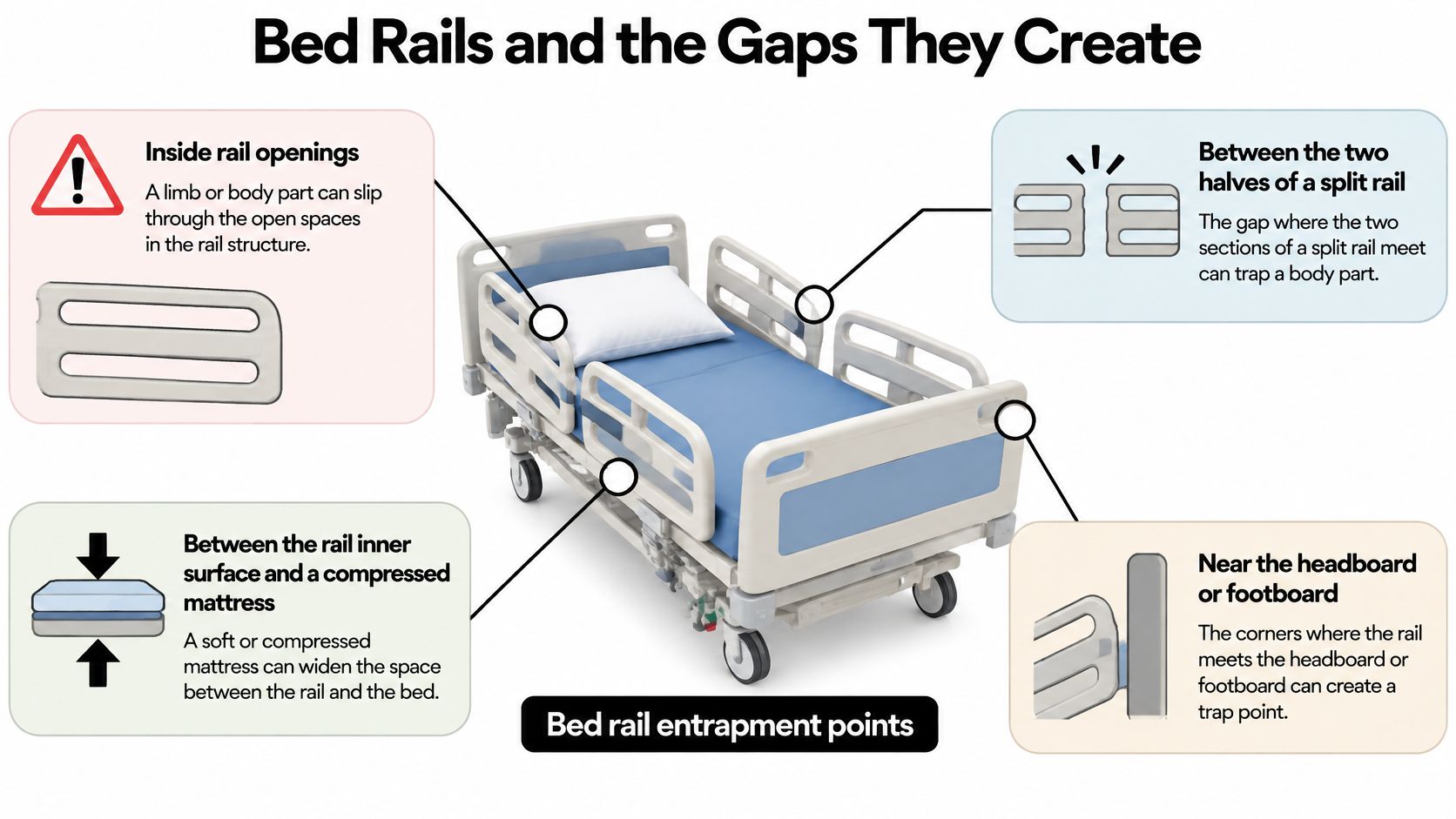
Bed Rails and the Gaps They Create
Entrapment means more than falling between a rail and mattress. A person can become caught inside a rail opening, between split sections, beside the mattress, or near an endboard. A secure mounting bracket doesn't eliminate those other hazards.
The diagram shows the principal places to inspect.
Match the Rail to the Job
The FDA's clinical bed-safety guidance identifies entrapment hazards with half rails and both entrapment and climbing-related fall hazards with full-length rails. More coverage isn't automatically safer. A shorter handhold can preserve an exit route, but its open end still requires assessment.
| Option | What it does | Where risk increases | Verify before use |
|---|---|---|---|
| Full-length rail | Continuous side barrier and repositioning handhold | Mattress-side entrapment and climbing over the rail | Height above loaded mattress and secure mattress interface |
| Half rail | Head-end handhold with an open foot-end exit | Rail openings and exposed rail end | User can reach and use the exit route safely |
| Quarter rail or small assist rail | Compact sitting-up handhold | Head or neck capture at the end | End interface and applicable portable-rail conformity |
| Split rail pair | Separate head and foot sections | Space between raised sections | Permitted inter-section spacing throughout adjustment |
| Adjustable or repositionable rail | Changes position for access and care | New openings after movement | Reassessment in every intended position |
| Under-mattress portable rail | Adds a handhold to a compatible home bed | Mattress-side gap and loosening attachment | Approved mattress thickness and secure retention |
| Transfer pole | Standing support beside the bed | Base movement or tipping under load | Stable mounting and appropriate user rating |
| No rail, with lower bed and floor mat | Lowers exit height and cushions the landing area | No barrier against an unintended exit | Safe exit plan and unobstructed caregiver access |
Why a Solid Rail Can Still Be Unsafe
A mattress that shifts, overhangs, or has a very soft perimeter may leave a changing opening beside a rigid rail. When someone rolls toward that edge, their weight can expose space that wasn't visible during an unloaded inspection. Use a manufacturer-approved firm inlay or a mattress designed to form a secure interface, rather than stuffing loose cushions into the opening.
Our bed rail installation guide can help organize the installation work, but the specific product instructions govern attachment and locking. Check that the rail latches fully and remains secure through the bed's intended movements.
Use the following video as supplementary viewing, not as a substitute for model-specific instructions.
The final choice depends on cognition, mobility, fall history, medication effects, and the ability to leave bed safely. Assess whether the person understands the handhold, can release it, and can follow the intended exit route. A product's size alone can't answer those questions.
Support Surfaces and What They Do to Fit
A pressure-management mattress changes both the support beneath a person and their position relative to the surrounding hardware. The right surface must meet the person's care needs while remaining compatible with the frame and rails. Comfort alone isn't a sufficient selection test.
The International Pressure Injury Guideline's repositioning guidance states that people with pressure injuries or at risk of them should be repositioned regardless of the pressure-redistribution surface used. A powered mattress doesn't replace a repositioning plan. Caregivers still need to assess skin, posture, movement, and whether vulnerable areas are offloaded.
Know What the Surface Is Designed to Do
- Standard foam: Provides a basic sleeping surface. It must remain supportive and match the deck's articulation and dimensions.
- High-density foam: Offers a different support construction, but density alone doesn't establish clinical suitability or pressure-management performance.
- Alternating pressure: Uses a pump to inflate and deflate air cells, changing support across the body over time.
- Low-air-loss: Uses airflow to help manage the skin's heat and moisture environment. It isn't synonymous with alternating pressure, although a system may combine them.
- Gel or visco overlay: Adds a conforming layer above the mattress. It also changes total surface height and may affect movement.
For a closer comparison of replacement surfaces, our hospital mattress guide provides additional selection context. Choose by the care problem, not by the most elaborate feature name.
Account for Height and Edge Behaviour
An overlay raises the sleeping surface relative to the rail. Even when the mounting hardware stays untouched, the user now meets the rail at a different height. Don't assume an overlay is harmless because it's removable.
A powered surface also changes shape during use. Evaluate its perimeter in the operating conditions specified by the manufacturer, rather than judging only a freshly inflated mattress. Keep the pump secured in its intended position, with tubing free from pinching during articulation.
A therapeutic surface can meet a pressure-management need and still be incompatible with the surrounding bed hardware.
Bedding needs its own fit check. SouthShore Fine Linens' guidance on deep pocket sheets for adjustable bases offers practical context for sheets that stay fitted during movement; specialized support surfaces still require their manufacturer's bedding instructions.
Finish by checking the actual mattress dimensions, ensuring it doesn't force the rails outward, and removing objects from beneath the person. A phone, cutlery, or a medical device left in the bed can create localized pressure that an advanced mattress won't automatically resolve.
Positioning, Transfer and Bedside Aids
Begin with the movement the person needs to complete. Sitting up, turning, standing, and moving to a chair require different abilities and equipment. An aid is appropriate only when the person and caregiver can use it safely for that specific task.
Help With Moving
A trapeze bar provides an overhead handhold from a compatible supporting frame. It may help someone reposition when they have sufficient upper-body strength, balance, and control, but it isn't a substitute for a lift. Our hospital-bed trapeze guide explains the equipment's intended role.
Bed handles commonly use an under-mattress support, while transfer poles may use a separate floor or structural mounting system. Don't assume all upright handles attach alike. The FDA's healthcare-provider recommendations note that some consumer accessories, including under-mattress rails and transfer poles, aren't currently regulated as medical devices; marketing language therefore can't replace a stability and suitability assessment.
For someone who cannot be moved safely by hand, the VA/Department of Defense pressure-injury guideline recommends considering mechanical lifts and friction-reducing devices for repositioning and mobilization. A slide sheet reduces dragging during an appropriate handling technique; it doesn't provide the lifting support of a mechanical lift.
Support Position and Daily Care
- Wedges and heel protectors: Position them to offload the intended area without driving the person against a rail. Check that edges and straps don't introduce a new pressure point.
- Overbed tables: Set the height to clear the user's lap and the rail throughout the intended bed movement. Don't use the tabletop as a standing support.
- Bumpers and padding: Confirm that fasteners stay secure and that the rail still locks visibly and completely. Padding must not conceal an unresolved capture space.
- Bed extenders: Match the longer deck with an approved mattress arrangement. Extra frame length alone doesn't provide supported sleeping space.
Tip Top Furniture & Mattresses' discussion of better sleep with adjustable bed frames provides general context for adjustable positioning. Clinical transfer and offloading decisions need a more individualized assessment than comfort preferences alone.
Before using any aid, check its attachment points, load rating, and travel path. Route catheters, drainage tubing, and other lines so movement won't pull them. Leave enough clear space for the caregiver to complete the task without twisting around furniture or reaching across an unstable support.
When a Rail Is the Wrong Accessory
A rail can increase risk. The FDA's advice for consumers and caregivers warns that climbing over a rail can cause serious injury or death and that rails shouldn't replace monitoring. A handhold suitable for a calm person may be inappropriate for someone who is confused, restless, or unable to free themselves.
Challenge the Assumption Before Buying
Rails don't prevent every fall. Someone may attempt to climb over the barrier instead of using an intended exit, creating a more dangerous movement.
More rail isn't always safer. Extending coverage can obstruct an exit the person otherwise knows how to use. The question is whether the chosen support helps that individual, not whether it encloses more mattress.
A rail cannot stand in for supervision. Nor does buying a hospital-style bed settle the safety question. Changes in illness, medication, strength, and behaviour can make a previously workable arrangement unsuitable.
If the main purpose is to keep someone in bed against their attempts to leave, review the care plan rather than adding another barrier.
Choose an Alternative That Addresses the Cause
- Lower bed height and a floor mat: Reduce the distance to the floor and provide a cushioned landing area. Keep the mat from becoming a trip or transfer obstacle.
- Motion or exit alerts: Notify a caregiver that movement is occurring. An alarm is useful only when someone can respond; our guide to bed alarms for dementia patients explains their role.
- Transfer pole: Provides a standing handhold when the person can use it safely. It doesn't restrain someone or replace hands-on assistance.
- Bedside commode: Shortens the route for toileting when it suits the person's abilities and available assistance.
- Scheduled checks: Allow caregivers to address discomfort, toileting, positioning, or other needs before the person attempts an unsupported movement.
- Caregiver training and a clear floor: Improve the planned transfer route and handling technique without adding hardware beside the mattress.
Say someone repeatedly tries to leave bed at night to reach the bathroom. A taller barrier doesn't address the toileting need. A care-plan review might instead identify a commode, a clearer route, scheduled assistance, or a different transfer method.
Define the problem before selecting the product: what movement needs support, and what new hazard would this accessory introduce?
Confirm Your Bed System Before You Order
Make the decision in a simple sequence: name the problem, verify the fit, and reassess after changes. Ordering a bed and its documented rail option together reduces the guesswork of matching unrelated listings, although the finished setup still needs inspection.
Our Medline MedLite Full-Electric Homecare Bed costs $699.00 frame only, $749.00 with half or full rails, and $819.00 to $929.00 in mattress packages. It has a 450 lb capacity, a 14.5 to 22.5-inch height range, and 3-inch casters. Select the documented configuration rather than assuming any separately advertised rail will fit.
For a less hospital-like appearance, the Flexabed Hi-Low SL Adjustable Bed is a luxury alternative available in Twin Hi-Lo, Full Hi-Lo, Queen Hi-Lo, and Dual King Hi-Lo widths of 38, 54, 60, and 76 inches, respectively. Any rail still needs explicit compatibility documentation.
Keep the manual with the bed and review return terms before ordering. We offer nationwide free shipping, a 30-day return policy on most items, and FSA/HSA-eligible products.
One accessory, one problem, one verified fit.
DME Superstore offers homecare beds, pressure-management mattresses, rails, and transfer aids to support care at home. Visit DME Superstore with your bed model, mattress measurements, and care task in hand to compare specifications and identify a compatible setup before ordering.
