



Installing grab bars for elderly users is one of the most effective measures for creating a safer home environment. These simple, sturdy devices provide critical support in high-risk areas like bathrooms, dramatically reducing the potential for falls and empowering older adults to maintain their independence and confidence.
Why Grab Bars Are an Essential Home Safety Device
A grab bar in a bathroom can be compared to a seatbelt in a car. It is a fundamental safety feature that significantly reduces the risk of serious injury in an area where it is most needed. For seniors, bathrooms present numerous challenges, with slippery surfaces and frequent transitions between sitting and standing.
These safety devices are more than just handles—they are tools for empowerment. They provide older adults with the stability needed to navigate challenging spaces independently. By offering a stable anchor point, grab bars transform daily routines that may cause anxiety into manageable, self-sufficient tasks.
The Impact of Grab Bars on Senior Safety
The benefits of properly installed grab bars extend beyond physical support. They provide significant peace of mind for both users and their families, fostering a sense of security that promotes greater autonomy.
Key advantages include:
- Fall Prevention: According to the CDC, falls are a leading cause of injury among older adults. Grab bars provide a secure handhold to prevent slips, particularly on wet bathroom surfaces. To learn more, read our guide on how to prevent elderly falls.
- Enhanced Mobility: Movements such as rising from a toilet or stepping out of a shower become significantly easier and safer. This support encourages regular movement, which helps maintain muscle strength.
- Greater Independence: By enabling self-care, grab bars serve as a cornerstone of aging in place. They reduce the need for assistance, preserving privacy and dignity.
Research indicates that seniors with grab bars are 75% more likely to regain their balance if they slip while exiting a bathtub compared to those without. This statistic underscores their critical role in preventing a slip from escalating into a serious fall.
Ultimately, installing grab bars is a proactive and empowering home modification. To better understand their application in various settings, consult this comprehensive guide to the best grab bars for showers.
Exploring Grab Bar Types, Materials, and Styles
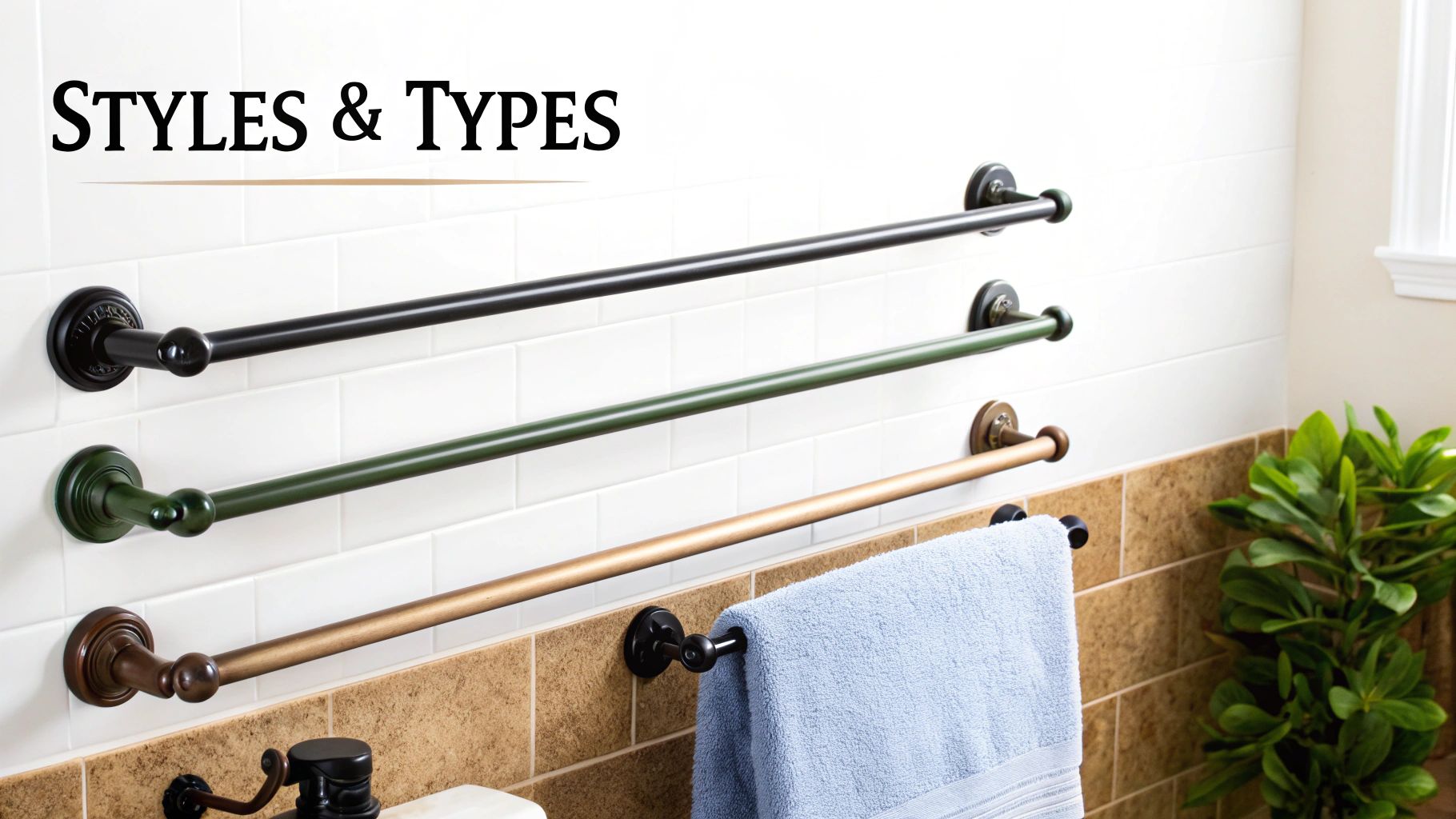
Selecting the appropriate grab bars for elderly users requires careful consideration of several factors. The optimal choice depends on the installation location, the specific mobility needs of the individual, and the bathroom's aesthetic. Modern grab bars are designed to offer a blend of both safety and style.
The selection process is similar to choosing the right tool for a specific task. The first step is to understand the different designs available, as each shape is engineered for a distinct purpose, offering support precisely where it is most needed.
Common Grab Bar Designs and Their Uses
The design of a grab bar is directly related to how it supports a person's movement. By analyzing a daily routine—such as exiting the shower or standing up from the toilet—you can identify the most suitable design.
Here are the primary types you will encounter:
- Straight Grab Bars: These are the most common type of bathroom safety bar. Versatile and straightforward, they can be installed horizontally, vertically, or diagonally to assist with a variety of movements. A vertical bar, for example, is ideal for a steadying grip when stepping in or out of a bathtub.
- Angled Grab Bars: Often set at a 45-degree angle, these bars provide a natural gripping position when changing levels, such as moving from a seated to a standing position. The slope supports the forearm and hand, making the transition feel more secure.
- L-Shaped and T-Shaped Bars: These designs combine horizontal and vertical support in a single unit. An L-shaped bar is highly effective next to a toilet, offering a horizontal section for pushing up from and a vertical one for pulling up with.
The demand for these safety devices is increasing. The global grab bar market was valued at approximately USD 180 million in 2021 and is projected to reach USD 250 million by 2027. This growth is driven by the aging population and greater awareness of home safety. You can learn more about market trends for grab bars.
Choosing the Right Material and Style
Once you have determined the necessary shape, the next consideration is the material and style. This allows you to match the grab bar to your bathroom's decor, ensuring it integrates seamlessly rather than appearing as a clinical addition.
When selecting a grab bar, the material affects not only its appearance but also its durability, grip, and maintenance requirements. The right material ensures the grab bar will be a reliable safety feature for years.
Grab Bar Material Comparison Guide
| Material | Pros | Cons | Best For |
|---|---|---|---|
| Stainless Steel | Extremely durable, rust-proof, easy to clean, wide range of finishes. | Can be cold to the touch; smooth finishes can be slippery when wet. | High-moisture areas like showers and tubs; versatile for any bathroom style. |
| Plastic/Composite | Warm to the touch, lightweight, affordable, often has a textured grip. | Can become brittle over time; may have a lower weight capacity than metal. | Budget-conscious installations or for users sensitive to cold surfaces. |
| Peened/Textured | Excellent non-slip grip, even when wet. | Surface can be harder to clean. | Inside the shower or anywhere a secure, wet grip is the top priority. |
| Decorative (Bronze, Brass) | Aesthetically pleasing, matches high-end fixtures. | Often more expensive; may require more maintenance to prevent tarnishing. | Bathrooms where style is just as important as safety. |
Choosing the right material involves balancing function and form. Stainless steel is the most popular choice due to its strength, resistance to rust, and suitability for wet environments. For those who prefer a warmer touch, bars made from plastic composites or featuring textured rubber grips feel less cold and can offer a superior grip.
You do not have to compromise on style. Finishes now range from classic chrome and brushed nickel to modern matte black and oil-rubbed bronze, making it easy to find an option that matches your existing fixtures and integrates this critical safety feature into your home's design.
Mastering Placement with ADA Best Practices
Installing a grab bar correctly is only part of the process; its placement is what determines its effectiveness as a safety tool. While the Americans with Disabilities Act (ADA) guidelines were developed for public spaces, they provide an excellent framework for residential installations.
Following these best practices for grab bars for elderly users ensures they are positioned for maximum leverage and support. These are not arbitrary measurements; they are based on extensive research into body mechanics and are designed to place support exactly where a person instinctively reaches when they lose balance or need assistance. This approach removes guesswork from the installation process.
The Gold Standard for Toilet Placement
The area around the toilet is a critical zone for fall prevention. The act of sitting and standing requires significant lower body strength and balance, making it a high-risk activity. The ADA guidelines recommend a two-bar configuration to provide comprehensive support.
This configuration includes:
- A rear wall grab bar: This bar should be at least 36 inches long and mounted horizontally. Its top edge should be positioned between 33 and 36 inches from the floor.
- A side wall grab bar: This bar should be at least 42 inches long and mounted at the same 33- to 36-inch height. It should begin no more than 12 inches from the rear wall to provide a continuous handhold.
This combination allows a person to use both arms for support—pushing off the side bar while pulling on the rear bar—to stand safely and with less strain.
Key Takeaway: The purpose of ADA placement is to create a predictable "support zone." By mounting bars at a consistent height of 33 to 36 inches, a user can locate the support by touch and instinct, which is critical during an unexpected slip.
Ideal Grab Bar Placement for Showers and Tubs
Showers and bathtubs are common locations for slips and falls due to wet, slick surfaces. Here, proper grab bar placement is essential for supporting movement during entry, bathing, and exit. ADA guidelines suggest a multi-bar configuration to address all phases of movement.
For a standard bathtub or shower, a layered support system is recommended:
- A vertical grab bar near the entrance. An 18 to 24-inch bar provides a solid handhold for stepping in and out over the tub ledge.
- A long horizontal grab bar on the back wall. This should be mounted at the standard 33 to 36 inches from the floor, offering steady support while standing or shifting position.
- A second horizontal bar on the control wall (the wall with the faucet). This offers another point of contact for stability when reaching to adjust water temperature or access toiletries.
These specific locations create a continuous chain of support, allowing a person to move confidently from one point to the next.
Understanding these principles is the first step. When you are ready for installation, our detailed guide on how to install grab bars in a bathroom provides technical instructions. By combining ADA best practices with a secure installation, you can transform a simple bar into a vital safety device.
Securing Your Grab Bar The Right Way
The effectiveness of a grab bar is entirely dependent on its installation. Its ability to provide support in a critical moment relies on how solidly it is attached to the wall. This is a non-negotiable aspect of converting a metal bar into a reliable safety device.
A wall's internal structure includes strong wooden beams called studs. Whenever possible, anchoring the grab bar directly into these studs is the best practice. A screw driven deep into a stud creates a powerful bond capable of supporting hundreds of pounds, providing a rock-solid foundation.
Studs vs. Hollow Wall Anchors
The first step in any installation is to locate the wall studs. This can be done with an electronic stud finder or by tapping along the wall and listening for a change from a hollow to a solid sound. Securing grab bars for elderly users directly into this wood frame guarantees maximum strength.
However, studs may not always be located precisely where a grab bar is needed. In such cases, specialized hollow-wall anchors must be used. These are not the light-duty plastic anchors used for hanging pictures; they are heavy-duty hardware engineered to expand behind the drywall, distributing the weight over a larger surface area to prevent the bar from being pulled out of the wall.
A professional installation eliminates guesswork. An expert has the proper tools to locate studs with precision and knows which type of heavy-duty anchor to use when a stud is not available. This is the only way to ensure the grab bar will meet its specified weight capacity.
This concept map illustrates the most critical locations for grab bars in a bathroom to create a complete safety system.
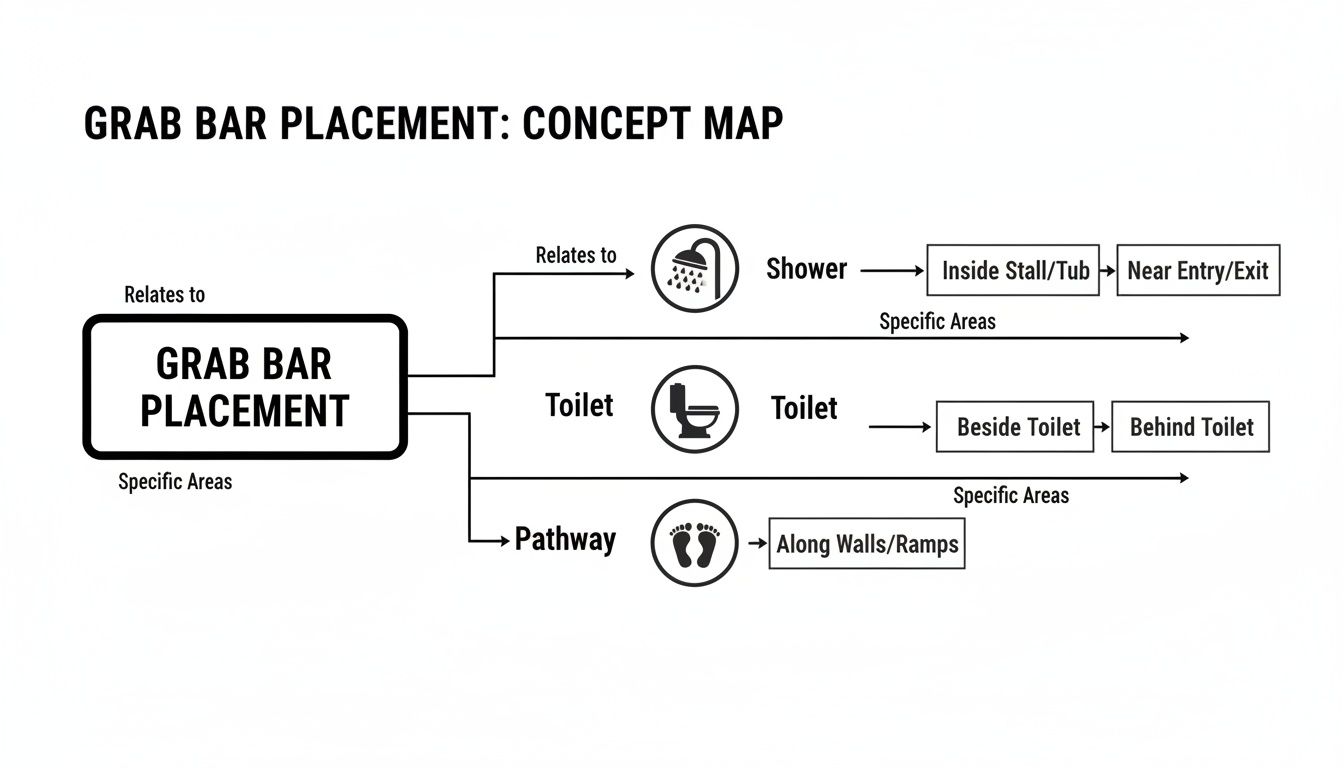
As shown, strategically placed bars in the shower, next to the toilet, and along key pathways work in concert to enhance the overall safety of the room.
Why Professional Installation Is Recommended
The demand for these safety products is growing because they are effective. The global grab bar market is projected to reach USD 1.83 billion by 2034, largely due to the aging population and the increasing preference for aging in place. Furthermore, well-planned bathroom modifications can reduce fall risks by up to 50%, demonstrating the significant impact of a properly installed grab bar. You can learn more about the growth of the grab bar market in recent studies.
While a DIY installation may seem feasible, the risks are high. A poorly mounted bar can fail under pressure, causing the very accident it was intended to prevent. For this reason, we strongly recommend hiring a professional. An expert will ensure every screw is secure and that the bar can handle the sudden, forceful weight shifts that occur during a slip, providing true peace of mind.
How to Choose the Right Size and Weight Capacity
Once you have determined the optimal placement for grab bars, the next step is to select the correct size and strength. These factors are as critical as location in ensuring the bar provides reliable support tailored to the user and the space.
The goal is to match the bar's length to its intended function. A short, stout bar is suitable for a single, powerful movement like standing up, while a longer bar is designed to provide a continuous handhold along a pathway.
Sizing Grab Bars for Specific Tasks
Different areas in the bathroom require different grab bar lengths to provide the best support. A bar’s size directly influences how it can be used to maintain balance and leverage body weight safely during movement.
Here is a guide to how common sizes are used for different applications:
- 12 to 16 inches: This shorter length is ideal for tight spaces. It serves as an effective single handhold next to a toilet, offering sufficient grip to assist with the sit-to-stand motion without being obtrusive.
- 24 to 32 inches: These are versatile, multi-purpose lengths. A 24-inch bar is well-suited for vertical installation at a shower entrance, while a 32-inch bar is effective when mounted horizontally on the back wall of a tub or shower.
- 42 to 48 inches: Longer bars are designed to create an extended, continuous path of support. A 42-inch bar is ideal for the side wall next to a toilet, providing a steady handhold over a longer distance.
A Quick Guide to Grab Bar Placement and Sizing
This reference table summarizes the most common locations with their recommended bar lengths and ADA-standard heights, serving as a guide for planning a safe bathroom layout.
| Location | Recommended Length (inches) | Recommended Height (from floor) |
|---|---|---|
| Next to Toilet (Side Wall) | 42" | 33" - 36" (top of bar) |
| Behind Toilet (Rear Wall) | 24" - 36" | 33" - 36" (top of bar) |
| Shower/Tub (Back Wall) | 24" - 36" | 33" - 36" (horizontal) |
| Shower/Tub (Control Wall) | 18" - 24" | 33" - 36" (vertical or horizontal) |
| Shower Entrance | 18" - 24" | 33" - 36" (vertical) |
Note that these are standard guidelines. They should always be adapted to the specific needs and comfort of the individual user.
Understanding Weight Capacity
A grab bar’s weight capacity is its most important safety specification. Standard ADA-compliant bars are engineered to support between 250 and 500 pounds—when installed correctly into wall studs. It is crucial to choose a bar with a rating that significantly exceeds the user’s body weight to account for the dynamic force exerted during a slip or fall.
For individuals requiring more robust support, bariatric grab bars are the appropriate choice. These are specifically constructed to handle much higher weight capacities, often well over 500 pounds, providing an essential layer of security.
The growing demand for these products reflects a larger trend. As more seniors choose to live independently, the grab bar market is projected to expand from USD 909.80 million in 2025 to USD 1,379.79 million by 2032. You can discover more insights about the grab bar market and its impact on home safety.
A critical rule of thumb is to select a grab bar with a weight capacity that is at least 1.5 times the user's weight. This safety margin ensures the bar can withstand the dynamic force of a sudden grab without failure.
Smart Features for Enhanced Safety
In addition to size and strength, modern grab bars offer features that provide extra layers of safety and convenience. Look for bars with a textured or knurled finish. These non-slip grips are vital in wet environments like a shower, where a smooth surface can become slippery. Our Medline Knurled Chrome Grab Bars are an excellent example of this high-grip design.
Some models also feature integrated shelving or soap dishes, which combine storage with support. This design reduces the need for users to bend or reach for toiletries, another common cause of falls in the bathroom.
Your Partner in Home Safety and Support
Choosing the right grab bars for elderly users is a significant step toward creating a safer home. At DME Superstore, we are committed to being your long-term partner in this journey. Our goal is to provide ongoing support to make the entire process easier and more manageable.
We understand that safety modifications are an important investment. That is why our products, including grab bars, are eligible for payment using your Flexible Spending Account (FSA) or Health Savings Account (HSA). For those who prefer to spread out the cost, we offer convenient financing options through Affirm, allowing you to break down the purchase into simple monthly payments.
More Than Just a Purchase
We want you to feel confident and supported from the moment you begin your research until long after your grab bars are installed. We have built our service on a foundation of trust and convenience.
This commitment includes valuable benefits like:
- Free Nationwide Shipping on every order.
- A 30-Day Return Policy on most items for peace of mind.
- 24/7 Chat Support to answer your questions whenever they arise.
For a broader perspective on how these modifications contribute to long-term independence, it is beneficial to explore the benefits of aging in place bathroom design.
Your Long-Term Safety Partner: We believe in empowering you with the tools and knowledge needed for lasting security. Our support extends beyond the transaction to ensure your equipment continues to serve you reliably for years to come.
Simple Maintenance for Lasting Security
To ensure your grab bars remain a reliable safety feature, periodic inspection is all that is required. A securely mounted bar is a safe bar.
Here is a simple checklist to perform every few months:
- Check for Wiggle: Firmly grasp each bar and attempt to move it. There should be absolutely no movement or play.
- Inspect Mount Points: Closely examine where the bar connects to the wall for any gaps, cracks, or signs of loosening.
- Tighten Screws: If you notice any slight movement, carefully tighten the mounting screws. If the bar remains loose, it is best to consult a professional.
This proactive approach ensures your investment continues to provide the dependable support your family relies on.
Common Questions About Grab Bars
As you finalize your home safety plan, several common questions may arise. Addressing these directly can help you feel confident about installing grab bars for elderly family members.
One of the most frequent questions concerns suction cup grab bars. While they appear convenient, it is critical to understand that they are intended only for balance assistance, not for supporting a person's full body weight. Unlike a securely mounted bar, a suction cup can fail suddenly and without warning, transforming a stability aid into a serious hazard.
Clarifying Installation and Care
"Can I install it myself?" is another common query. Although it may seem like a straightforward DIY project, a grab bar's strength is determined by its mounting. We must emphasize that professional installation is the best method to ensure the bar is anchored securely into wall studs. This guarantees it can withstand the intense force of a slip or fall. For true safety, this step is essential.
Once installed, proper care of your grab bars is simple but important.
- Cleaning: Use a mild, non-abrasive cleaner and a soft cloth. Harsh chemicals can damage the finish and reduce the grip of the surface over time.
- Drying: Wiping the bar down after each use will prevent water spots and maintain its appearance.
- Inspecting: Periodically give the bar a firm tug to ensure it remains solidly attached to the wall with no movement.
A key insight is that grab bars and shower chairs are complementary safety tools. A shower chair provides stability while seated, but grab bars are essential for the critical moments of sitting down, standing up, and transferring safely in and out of the shower.
This can be viewed as a two-part safety system. Each component addresses a different type of movement, and together they create a comprehensive solution that helps prevent falls. By understanding these key distinctions, you can build a secure bathroom environment that supports independence and provides invaluable peace of mind.
At DME Superstore, we're committed to being your partner in creating a safer, more accessible home. Explore our complete selection of bathroom safety equipment to find the perfect solutions for your needs. Visit us at https://dmesuperstore.com to get started today.

