



For individuals seeking to age gracefully and maintain their independence at home, the right equipment is not just a convenience—it's a necessity. The best lift chairs for the elderly are specifically engineered to support this goal, blending safety, comfort, and assistive technology into one essential piece of durable medical equipment. A quality lift chair is far more than a comfortable recliner—it is a specialized medical device designed to mitigate fall risks and preserve dignity by providing a stable, mechanical lift to a standing position.
Understanding the Role of a Lift Chair in Senior Independence
For many older adults, the seemingly simple act of standing up from a chair can become a daily physical challenge, potentially leading to a loss of confidence and increased reliance on caregivers. A lift chair is designed to directly address this issue. It is not merely furniture; it is a cornerstone of safe, independent living that empowers users by restoring a degree of self-sufficiency.
This assistive function is a significant factor in helping seniors thrive safely within their own homes. By reducing the physical strain on the knees, hips, and back, a lift chair makes mobility less daunting and considerably safer. To fully appreciate its function, it's helpful to understand What Is A Lift Chair.
Enhancing Quality of Life Through Safety and Mobility
At its core, a lift chair’s primary medical function is to gently guide a person from a seated to a near-standing position. This mechanical assistance dramatically minimizes the risk of falls, a major health concern for seniors and a source of anxiety for their families. This single feature can have a profound impact on an individual's daily life.
A lift chair is a powerful tool for aging in place safely. It directly tackles one of the most common physical hurdles of growing older by providing a secure, effortless way to stand, empowering individuals to live more confidently and comfortably in their own space.
This enhancement in safety naturally fosters a greater sense of autonomy. The ability to stand without assistance means a senior can more easily answer the door, prepare a meal, or simply move about their home on their own terms. You can learn more about how equipment like this supports at-home freedom in our guide on how to stay independent while aging in place.
The Growing Need for Advanced Mobility Solutions
The increasing demand for these chairs underscores their medical and social importance. The lift chair market is projected to expand from USD 1.7 billion in 2026 to USD 2.9 billion by 2032, a trend driven by a growing aging population. In the United States alone, more than 54 million people aged 65 and older contribute to the strong need for this type of supportive equipment.
Understanding the key differences between various models is crucial for selecting the right chair for an individual's specific health and lifestyle needs.
| Key Factor | Importance for Seniors | What to Consider |
|---|---|---|
| Chair Type | This determines the recline level and potential for therapeutic positioning. | Options range from basic 2-position chairs to advanced infinite-position models for specific health needs. |
| Essential Features | These have a direct impact on safety, comfort, and day-to-day convenience. | Look for a battery backup system, a simple remote, and durable, easy-to-clean fabrics. |
| Personal Fit | A proper fit ensures correct ergonomic support and prevents discomfort or pressure sores. | The chair’s dimensions must match the user’s height and weight for it to work safely and effectively. |
Ultimately, choosing the best lift chair comes down to matching these core factors to an individual's unique health needs and lifestyle.
Comparing Lift Chair Types for Different Needs
Choosing the best lift chair for yourself or a loved one is about much more than just picking out a nice fabric. It’s a decision that directly impacts daily comfort, safety, and independence. Not all lift chairs are the same—they’re designed with specific features for different levels of mobility and health needs.
A chair that’s a perfect match for one person could be completely wrong for another. Understanding the key differences is the first step toward making a smart choice.
To start, this simple visual can help you figure out if a lift chair is what you really need.
This flowchart nails the fundamental question: if getting up from a seated position is a struggle, a lift chair provides that crucial assistance a regular recliner just can't offer.
2-Position Chairs: The Simple and Effective Solution
Consider an individual who is largely independent but finds that standing up after watching television requires some extra effort. They don't need complex positioning options—just a reliable, straightforward boost. For this exact situation, a 2-position lift chair is often the perfect fit.
These are the most fundamental models, offering three core positions: sitting upright, a lifted position to assist with standing, and a slight recline for activities like reading. The remote control is typically a simple two-button device, which is ideal for anyone who prefers uncomplicated operation.
Because their design prioritizes the essential lifting function, 2-position chairs are often more compact and budget-friendly, making them an excellent entry-level option for smaller living spaces.
3-Position Chairs: For All-Day Comfort
Now, picture someone who spends a significant portion of their day in their recliner for reading, napping, and watching movies. This user requires a chair that can provide sustained comfort for hours at a time. This is where the 3-position lift chair excels.
A 3-position chair offers all the functionality of a 2-position model but adds a much deeper recline that is nearly flat—perfect for a comfortable nap. While the backrest and footrest still move in a synchronized motion, this extended range makes a substantial difference for lounging and relaxation.
For many people, the 3-position lift chair hits that sweet spot between essential lift help and versatile comfort, making it the most popular choice for everyday use.
This blend of features has made it a market favorite. In fact, models offering greater therapeutic benefits now command over 60% of the market share. This isn't just a trend; it's driven by real results. User surveys show these chairs can help lower the incidence of back pain by as much as 35%. The lift chair market, valued at USD 3.84 billion in 2022, is expected to hit USD 5.78 billion by 2028, reflecting just how important these chairs have become in home care.
Infinite-Position Chairs: Therapeutic and Customizable
For an individual managing chronic health conditions such as edema, poor circulation, severe arthritis, or persistent back pain, a lift chair functions as a critical medical tool. The infinite-position lift chair is engineered for these precise scenarios, offering unparalleled customization.
Unlike other models, these chairs utilize dual motors, which means the backrest and footrest can be controlled independently. This is a game-changer. It allows the user to find the precise angle to relieve pressure on aching joints, elevate their legs to reduce swelling, or achieve a true zero-gravity position for sleep.
Many infinite-position chairs also offer advanced, therapeutic positions:
- Zero-Gravity: This position raises the feet to be slightly above the heart, a posture clinically shown to improve circulation, relieve spinal pressure, and decrease swelling.
- Trendelenburg Position: By elevating the feet even higher than the heart, this position is sometimes recommended by doctors for specific circulatory or breathing conditions.
These capabilities transform the chair from a simple piece of furniture into a sophisticated wellness tool for managing daily symptoms and pain.
Specialized Lift Chairs: For Unique Needs
Beyond the main categories, some lift chairs are built to solve very specific problems.
- Bariatric Lift Chairs: Engineered with reinforced steel frames and heavy-duty motors, these chairs are built to safely support higher weight capacities, often 500 lbs or more. They also feature wider seats to ensure a comfortable and secure fit.
- Wall Hugger Lift Chairs: These are brilliant for apartments or any room where space is tight. They are designed to recline fully while needing just a few inches of clearance from the wall, as the chair base slides forward while the back reclines.
In some situations, a user may only need the lifting function without any recline at all. To learn more about this specific option, you can read our guide on what a straight lift mechanism is.
To help you visualize which chair might be the best fit, we've put together this quick comparison table.
Matching Lift Chair Types to User Scenarios
This table helps you quickly identify the most suitable lift chair by matching common user needs and living situations with the best chair type.
| Lift Chair Type | Ideal User Scenario | Key Differentiating Feature | Best Suited Living Space |
|---|---|---|---|
| 2-Position | Needs basic lift assistance for standing; enjoys reading or watching TV while seated. | Simple, two-button operation with limited recline. | Smaller rooms, apartments, or budget-focused. |
| 3-Position | Spends significant time in the chair and enjoys napping; seeks all-day comfort. | Deeper recline suitable for napping; back and footrest move together. | General living rooms; most popular choice. |
| Infinite-Position | Manages chronic pain, swelling, or circulatory issues; needs precise, therapeutic positioning. | Dual motors allow independent back and leg adjustment. | Anywhere therapeutic comfort is a priority. |
| Bariatric | Requires a higher weight capacity and a wider, more durable frame for safety. | Reinforced frame supporting 500+ lbs; wider seat. | Spaces that can accommodate a larger chair. |
| Wall Hugger | Lives in a small apartment or has limited space behind the chair. | Slides forward as it reclines, requiring minimal wall clearance. | Compact living areas, bedrooms, or dens. |
Ultimately, the best lift chair is the one that fits the user's specific daily routines, health requirements, and living space perfectly. By matching the features to the person, you ensure the chair will be a source of comfort and independence for years to come.
Diving Into the Features That Matter Most
Once you’ve determined the type of lift chair that best suits the user's needs, the next step is to examine the specific features that distinguish a good chair from a great one. These are not merely cosmetic add-ons; they are functional details that directly impact safety, comfort, and ease of use. This section moves beyond broad categories to explore the technical components that make a lift chair an effective partner in maintaining independence.
The remote control is the command center for the chair, making its design a critical element. A well-designed remote will feature large, backlit buttons for visibility in low light and a simple, intuitive layout to prevent user error.

Single Motor vs. Dual Motor Mechanisms
The motor is the engine that drives the chair's movement, and the choice between a single or dual motor design fundamentally changes its capabilities.
A single motor is the standard for 2-position and 3-position chairs. In these models, the backrest and the footrest are mechanically linked, moving in a synchronized motion. When you recline the back, the footrest rises automatically. This configuration is straightforward and effective for general relaxation and providing basic standing assistance.
However, this design has limitations. For example, a user cannot elevate their feet without also reclining their back. For anyone requiring more specific positioning for medical reasons, a dual motor system becomes essential.
Dual motor systems, which are the core of infinite-position chairs, provide independent control over the backrest and the footrest. This separation is a crucial advancement for managing comfort and health, enabling a virtually limitless combination of positions.
- Single Motor Scenario: An individual primarily needs a boost to stand and enjoys reading in a gentle recline. The simple, synchronized movement of a single motor meets these needs and is incredibly easy to operate.
- Dual Motor Scenario: A user with edema needs to elevate their legs high to reduce swelling but wants to remain sitting upright to watch TV or converse with family. A dual motor chair makes this possible; a single motor chair cannot achieve this position.
This level of customization is what elevates a chair from a comfortable recliner to a genuine piece of medical equipment.
The Non-Negotiable: A Battery Backup System
If there is one safety feature that is absolutely essential, it is the battery backup system. This is not a luxury option but a critical component. In the event of a power outage, a user could become stuck in a reclined position, unable to get up. A chair without a backup system poses a significant safety risk.
A battery backup ensures that even during a power outage, the chair has enough power for one full cycle to get back to a neutral sitting or lifted position. It’s an invaluable feature that provides true peace of mind, guaranteeing no one ever gets stranded in their own chair.
Typically powered by two standard 9-volt batteries, this system is designed for one-time emergency use to return the chair to a safe, upright position. It is a simple yet vital function that underscores the difference between standard furniture and durable medical equipment. Many modern chairs even include diagnostic tools to monitor battery health. You can see how some brands build this in by reading about systems like Smart-Tek technology.
Therapeutic Heat and Massage Functions
While they may seem like premium add-ons, therapeutic heat and massage systems offer tangible medical benefits for older adults managing chronic pain, stiffness, or poor circulation. These are not just for comfort—they are functional tools for pain management.
Heat therapy, typically concentrated in the lower back (lumbar) region, is effective for relaxing sore muscles, easing the joint stiffness associated with arthritis, and improving blood flow. This gentle warmth can provide significant, non-pharmacological relief.
Similarly, the massage function, which usually consists of gentle vibrations, can help stimulate circulation and soothe aching muscles. For anyone who remains seated for extended periods, this can make a world of difference in reducing discomfort.
Choosing the Right Fabric for Health and Durability
The final piece of the puzzle is the chair's upholstery. The fabric you choose directly affects comfort, how easy the chair is to keep clean, and even skin health over the long term.
| Fabric Type | Best For | Considerations |
|---|---|---|
| Performance Fabrics | High-traffic use; spills and accidents. | Often made from synthetics, these are designed to be stain-resistant, liquid-repellent, and incredibly easy to clean with just soap and water. |
| Leather/Vinyl | Durability and effortless cleaning. | Because they are non-porous, these surfaces are great for hygiene but can feel cold or sticky on the skin and aren't always very breathable. |
| Soft Fabrics (Chenille/Microfiber) | Maximum comfort and a warm, cozy feel. | While they feel wonderful, they are more likely to stain and can require more work to keep clean compared to performance fabrics or leather. |
For many seniors, especially those dealing with incontinence or who have sensitive skin, a high-performance, breathable fabric is the smartest choice. It strikes the perfect balance between easy maintenance and the soft comfort needed for hours of sitting, ensuring the chair stays both hygienic and inviting.
How to Measure for a Perfect and Safe Fit
An improperly sized lift chair is more than just an inconvenience—it can actually undermine the safety and support it’s meant to give you. When a chair is too big or too small, it can force you into poor posture, create painful pressure points, and even make the lifting mechanism less stable.
Getting it right isn’t complicated. A few simple measurements will ensure the chair fits the user’s body perfectly, maximizing all its ergonomic benefits and keeping them safe.
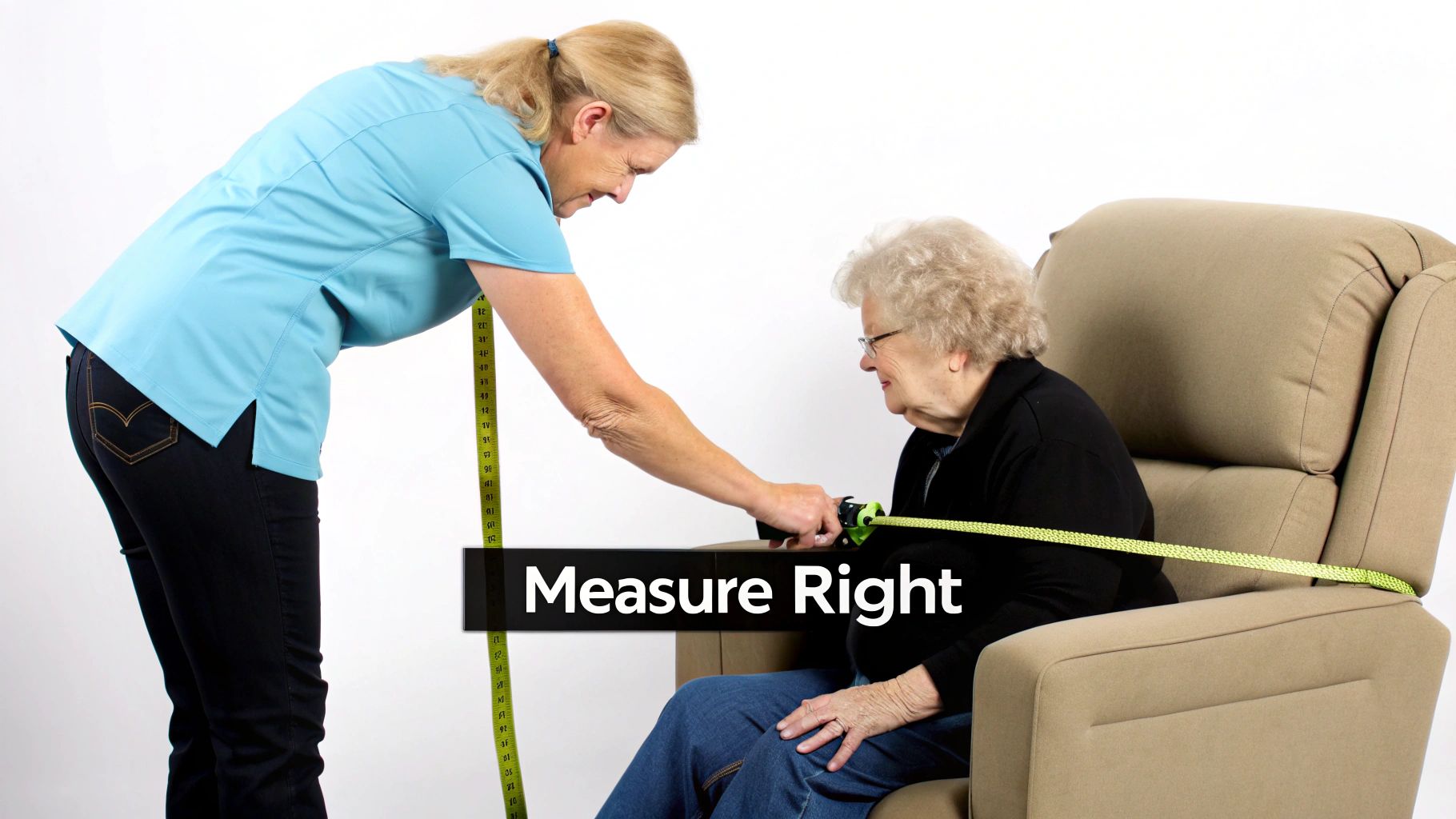
To start, you’ll just need a tape measure. Have the person who will be using the lift chair sit in a straight-backed dining chair. These three key measurements are the foundation for finding the absolute best fit.
Measuring the User for an Ideal Fit
The whole point here is to match the person’s dimensions to the chair’s specifications. A proper fit supports the body correctly from head to toe and prevents unnecessary strain.
-
Seat Height (Floor to Knee): While the user is seated with their feet flat on the floor and knees bent at a 90-degree angle, measure the distance from the floor up to the back of their knee. This number is critical for stability, as it ensures their feet can rest firmly on the ground when seated and before standing up.
-
Seat Depth (Knee to Hip): In that same seated position, measure from the back of the user’s hip all the way to the back of their knee. The perfect seat depth allows someone to sit with their back fully against the chair’s lumbar support, while still leaving about two to three fingers of space between the back of their knees and the edge of the seat cushion.
-
Seat Width (Hip to Hip): Now, measure the widest point across the user's hips or thighs while they are seated. Be sure to add at least one inch to this measurement. This extra room ensures the seat isn’t too snug, allowing for comfortable movement and preventing pressure on the hips.
An accurate fit is not a luxury—it’s a medical necessity. Proper seat depth is particularly important, as a seat that is too deep can cut off circulation behind the knees, while one that is too shallow fails to provide adequate thigh and lumbar support.
Matching Measurements to Chair Specifications
Once you have these numbers, you can confidently check them against the specs listed for different lift chair models. Top-tier brands like Pride Mobility and Golden Technologies always provide detailed dimension charts for every chair they make.
When you’re looking at a product page, keep an eye out for these key specs:
- Seat to Floor Height: This should closely match your user’s floor-to-knee measurement.
- Seat Depth: This should line up with the knee-to-hip measurement you took.
- Seat Width: This should be at least one inch wider than the user’s hip measurement.
- Weight Capacity: Always choose a chair with a weight capacity that comfortably exceeds the user’s current weight. This ensures the motor and frame can operate safely and without strain for the long haul.
Taking a few minutes to measure correctly transforms buying a lift chair from guesswork into a precise science. This simple step is the best way to guarantee the chair will deliver the safety, comfort, and independence the user deserves for years to come.
Navigating Your Purchase and Ownership
You’ve done the hard part—measuring for the perfect fit and picking the features that will make daily life easier. Now it’s time to handle the logistics of bringing your new lift chair home. Think of a quality lift chair as a long-term investment in your safety and independence. Understanding the purchase process, delivery, and ongoing care is key to making sure that investment pays off for years to come.
Using FSA or HSA Funds for Your Purchase
One of the most practical ways to manage the cost of a lift chair is by using pre-tax funds. The good news is that all lift chairs sold at DME Superstore are eligible for purchase with Flexible Spending Accounts (FSA) and Health Savings Accounts (HSA).
This is a huge advantage. It means you can pay for this essential piece of medical equipment with money you've already set aside, which also lowers your overall taxable income for the year. For extra flexibility, we also offer financing options through services like Affirm, which can break the total cost into smaller, more manageable monthly payments.
Understanding Your Warranty Coverage
A solid warranty is more than just a piece of paper; it’s a manufacturer's promise that they stand behind their product. It gives you peace of mind knowing your investment is protected. While the fine print varies between brands, most comprehensive warranties cover different parts of the chair for different lengths of time.
Here's a typical breakdown of what you can expect:
- Frame and Lifting Mechanism: These are the bones of the chair, built to last. It’s common to see a lifetime or multi-year warranty on these core components.
- Motor and Electronics: The parts that do the heavy lifting, like the motor and remote, are usually covered for a period of one to three years.
- Fabric and Upholstery: Since fabrics are subject to daily wear and tear, they generally have a shorter coverage period, often around one year.
Always take a moment to review the warranty details before you finalize your purchase. Knowing what’s covered and for how long helps you avoid surprises down the road.
Simple Maintenance for a Long Lifespan
Keeping your lift chair in top-notch condition doesn’t require a lot of work. A few simple, regular habits can make a huge difference in its performance and longevity, ensuring it operates smoothly and safely for years.
- Weekly Cleaning: Give the upholstery a gentle vacuuming to pick up dust and crumbs. If a spill happens, use a damp cloth with a mild soap-and-water solution, but always double-check the manufacturer’s cleaning codes first to be safe.
- Monthly Inspection: Do a quick check of all the power cords to make sure they aren’t frayed, pinched, or damaged. It's also a great time to test the battery backup system to ensure the batteries are still holding a charge.
- Annual Check-Up: Just listen. Do you hear any creaks, groans, or unusual noises coming from the motor or lift mechanism? If something sounds off, it’s always best to contact customer support for advice.
Your relationship with your lift chair provider shouldn't end at the checkout. Services like nationwide free shipping, white-glove delivery for a completely hands-off setup, and accessible customer support are what transform a simple purchase into a long-term partnership.
The growing demand for this kind of comprehensive service is reflected in the market itself. The global lift chair market reached approximately USD 3,954.2 million in 2024, with online e-commerce channels showing the fastest growth as people increasingly seek out convenient and supportive buying experiences. When you're ready to see what's out there, it helps to browse the full variety of lift chairs available to get a real feel for your options.
Your Top Lift Chair Questions Answered
When you're looking into durable medical equipment, it's natural to have a lot of questions. To help you feel confident in your decision, we've put together straightforward answers to the most common things people ask when choosing a lift chair.
Will Medicare or Insurance Help Pay for a Lift Chair?
This is easily one of the most important questions we get, and the answer has a few key details. Medicare Part B might cover a portion of the cost, but it's critical to know they only pay for the motorized lifting mechanism itself—not the whole chair.
For Medicare to even consider it, the lift mechanism has to be prescribed by a doctor as "durable medical equipment" (DME). This means your doctor needs to document a specific medical need, like severe arthritis or a neuromuscular disease, that makes it impossible for you to stand up from a regular chair without help.
Understand this key point: Medicare will not cover the "furniture" part of the chair—the frame, cushions, and fabric. Private insurance plans all have their own rules, so you'll need to call your provider directly to see what, if anything, they cover.
A much simpler and more popular route is using funds from a Flexible Spending Account (FSA) or Health Savings Account (HSA). Every lift chair we offer is eligible, allowing you to use pre-tax dollars to cover the entire cost. This makes the purchase significantly more affordable for many families.
What Is the Difference Between a Lift Chair and a Standard Recliner?
At a glance, they can look pretty similar, but a lift chair and a standard recliner are built for entirely different reasons. A normal recliner is all about comfort and relaxation—it lets you lean back, kick your feet up, and unwind.
A lift chair, however, is a piece of medical equipment designed for safety and mobility. The defining feature is its powered lifting mechanism, something a regular recliner just doesn't have. This powerful motor tilts the entire base of the chair up and forward, gently guiding the user to a near-standing position.
This single function is what makes it such an essential mobility aid. It takes a huge amount of strain off weak or painful joints in the knees, hips, and back. Most importantly, it's engineered to minimize the risk of falls, which often happen when someone struggles to get up from a seated position. A recliner is for lounging; a lift chair is a tool for independence.
How Difficult Is Lift Chair Assembly and Operation?
You'll be happy to know that manufacturers design these chairs to be incredibly user-friendly, right out of the box. Assembly is almost always a simple, tool-free process. The chair typically arrives in two main pieces—the base and the back—which are made to slide and lock securely into place. It’s that easy.
The remote control is already wired and ready to go. Using it is just as simple. The remotes have large, clearly labeled buttons, often with easy-to-understand pictures, to control the lift and recline functions. There’s no complicated programming to worry about.
For anyone who’d rather not deal with setup at all, we offer our "White Glove Delivery" service.
- Our professional team brings the chair right to the room you want it in.
- They handle the complete assembly and test every function to make sure it’s working perfectly.
- Before they leave, they clear away all the packaging materials, leaving you with a ready-to-use chair and no mess.
This service guarantees a totally seamless experience, so your new lift chair is ready for you the moment it arrives.
At DME Superstore, our mission is to provide you with the knowledge and tools needed to live safely and independently. Take a look at our curated selection of the industry's best lift chairs and find the perfect fit to improve your mobility and comfort today. https://dmesuperstore.com

